
Pheidole rhea
Wheeler, 1908
Pheidole rhea is a highly polymorphic native to the southwestern United States and northwestern Mexico. The species exhibits an exceptional three-tiered system comprising minor workers, soldiers, and supersoldiers—an unusual degree of physical within the . Colonies form large, aggressive societies that forage along conspicuous trunk trails to harvest seeds and insects. First described by Wheeler in 1908, this species has become a subject of interest for studying the relationship between morphological specialization and behavioral plasticity in social insects.
Pronunciation
How to pronounce Pheidole rhea: /ˈfaɪdoʊli ˈriːə/
These audio files are automatically generated. While they are not always 100% accurate, they are a good starting point.
Identification
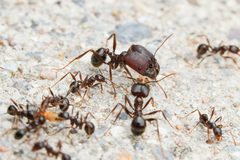
Distinguished from other Pheidole by the presence of three subcastes (minors, soldiers, supersoldiers) rather than the typical two- system. Supersoldiers are particularly diagnostic—substantially larger than soldiers with grossly enlarged . May be confused with other polymorphic Pheidole species; geographic location (southwestern US/northwestern Mexico) and (grassy slopes at mountain bases) provide supporting context. Aggressive colony defense and conspicuous trunk trails are additional field characteristics.
Images
Habitat
Grassy slopes and hills at the bases of mountains; lower portions of canyons in Arizona. Open, grass-dominated environments with adequate insolation.
Distribution
Southwestern United States (especially Arizona) and northwestern Mexico.
Diet
: consumes seeds and various insects. Seed harvesting is a major foraging activity.
Life Cycle
Complete typical of Formicidae. Colony foundation details not specified. Colonies reach large size with multiple queens ( not confirmed but suggested by large colony size).
Behavior
Forms large colonies with aggressive nest defense by all . cannot sting; majors and supersoldiers use enlarged for combat and seed-crushing. Constructs conspicuous trunk trails for foraging. Supersoldiers demonstrate enhanced chemosensory sensitivity, detecting at lower concentrations than minors or soldiers. Despite physical , behavioral programs for extranidal tasks (nest-search locomotion, aggressive defense) appear conserved across worker subcastes.
Ecological Role
Seed and harvester; contributes to seed and in arid grassland . Insect suggests role in . Large colony likely influences soil structure and nutrient cycling through nest construction and foraging activity.
Human Relevance
Bites from majors and supersoldiers are generally non-painful but can be irritating. Not documented as a significant agricultural pest or . Subject of scientific research on evolution and behavioral .
Similar Taxa
- Pheidole megacephalaAlso highly polymorphic with large-headed soldiers; however, P. megacephala is a globally distributed with different geographic origin and typically lacks the extreme supersoldier of P. rhea
- Other Pheidole speciesMost Pheidole exhibit only two (minors and majors); P. rhea is distinguished by the consistent production of three discrete subcastes including supersoldiers
More Details
Research significance
Pheidole rhea serves as a model organism for studying the decoupling of morphological and behavioral evolution in social insects. The demonstrates that extreme physical does not necessarily correlate with behavioral specialization for extranidal tasks.
Caste terminology
The term 'supersoldier' is used in the literature to describe the third ; these individuals are larger than typical soldiers and represent an extreme of allometry within the .
Sources and further reading
- BugGuide
- Wikipedia
- GBIF taxonomy match
- iNaturalist taxon
- NCBI Taxonomy
- Catalogue of Life
- Big-headed Ants Are Biggest in Australia Due to Competition
- Animals Alarmed! | Beetles In The Bush
- During Quarantine, an Entomologist Takes a Closer Look at a New Invasive Ant Species
- Fire ant winged reproductives: male and female | Beetles In The Bush
- Bug of the Week
- Limited size-related variation in behavioral performance among workers of the exceptionally polymorphic ant Pheidole rhea