
Pheidole porcula
Wheeler, 1908
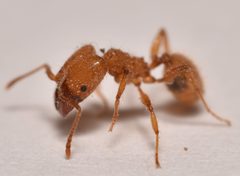
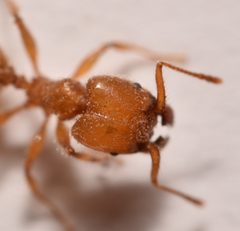
Pheidole porcula is a of big-headed ant in the Pheidole, described by Wheeler in 1908. As a member of this hyperdiverse genus, it exhibits the characteristic with distinct major and minor worker . The species is placed within the tribe Attini, though unlike the well-known fungus-growing ants in this tribe, most Pheidole species are foragers. Specific details about its and remain poorly documented in available literature.
Pronunciation
How to pronounce Pheidole porcula: /ˈfaɪdəˌli pɔrˈkjuːlə/
These audio files are automatically generated. While they are not always 100% accurate, they are a good starting point.
Identification
Identification to level within Pheidole requires examination of morphological characters including shape, mandibular , pilosity patterns, and petiole structure. P. porcula can be distinguished from through subtle differences in these features, though specific diagnostic characters for this species are not detailed in available literature. The species was described by Wheeler in 1908, suggesting it may be distinguishable from related through classic morphological .
Images
Appearance
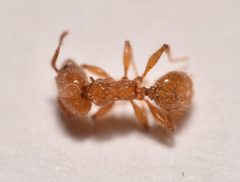
As a Pheidole , P. porcula exhibits with two distinct worker : minor workers and major workers (soldiers). Major workers possess disproportionately enlarged relative to their body size, housing powerful mandibular muscles used for defense, food processing, and nest maintenance. Minor workers have proportionally smaller heads and are more gracile in build. Specific coloration, size ranges, and distinguishing morphological features for this species are not documented in available sources.
Distribution
The precise native distribution of Pheidole porcula is not explicitly documented in available sources. As a Pheidole described in 1908, it likely occurs in the Neotropics or Nearctic region, where the is most diverse. The species has been recorded in iNaturalist with 22 observations, though specific locality data from these records are not provided in the available context.
Life Cycle
As a member of Formicidae, P. porcula undergoes complete with , larva, pupa, and stages. Colonies are eusocial with a reproductive , (major and minor ), and seasonal production of winged reproductive males and females. Specific details of colony founding, developmental timing, and reproductive for this are not documented.
Similar Taxa
- Other Pheidole speciesThe Pheidole contains over 1,000 described in the New World alone, many of which are morphologically similar and require careful examination of diagnostic characters for proper identification. P. porcula is distinguished from these through specific morphological features established in Wheeler's 1908 description.
More Details
Taxonomic Status
Pheidole porcula was described by Wheeler in 1908 and is currently recognized as a valid in the Catalogue of Life and GBIF. It is classified within the tribe Attini, a group that includes both fungus-growing ants and many non-fungus-growing such as Pheidole.
Data Availability
This is notably data-deficient. With only 22 iNaturalist observations and minimal published literature specifically addressing its , much of its natural history remains unknown. This reflects a broader pattern in myrmecology where hyperdiverse contain many species with limited study.
Sources and further reading
- BugGuide
- GBIF taxonomy match
- iNaturalist taxon
- Catalogue of Life
- Big-headed Ants Are Biggest in Australia Due to Competition
- During Quarantine, an Entomologist Takes a Closer Look at a New Invasive Ant Species
- Fire ant winged reproductives: male and female | Beetles In The Bush
- Hymenoptera | Blog - Part 7
- Bichos Argentinos #2 – Pseudomyrmex sp. | Beetles In The Bush
- Ants in the Nest: A Possible Emerging Pressure on Sea Turtles