
Pheidole morrisii
Forel, 1886
Morris' Big-headed Ant
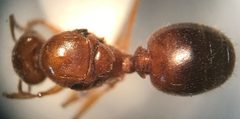
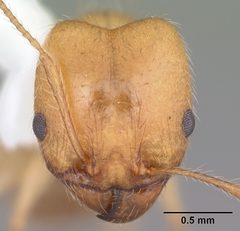
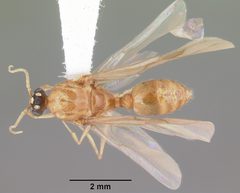
Pheidole morrisii is a of big-headed in the Pheidole, first described by Forel in 1886. Like other members of this hyperdiverse genus, it exhibits the characteristic dimorphic system with minor workers and major workers (soldiers) bearing disproportionately enlarged . The species belongs to the myrmicine and is part of the tribe Attini.
Pronunciation
How to pronounce Pheidole morrisii: //ˌfaɪˈdoʊli ˈmɒrɪsi.aɪ//
These audio files are automatically generated. While they are not always 100% accurate, they are a good starting point.
Identification
As a Pheidole , P. morrisii can be recognized by the presence of two distinct : minor workers with proportionate sizes and major workers (soldiers) with dramatically enlarged, -shaped heads used for defense and food processing. Specific identification to species level requires examination of morphological characters including head shape, mandibular structure, and body proportions, typically necessitating taxonomic keys. The species is distinguished from by subtle morphological differences in head , pilosity patterns, and body proportions that are documented in taxonomic revisions of the .
Images
Similar Taxa
- Pheidole megacephalaBoth are big-headed ants with dimorphic , but P. megacephala is a notorious global with established ecological impacts, whereas P. morrisii has not been documented as .
- Other Pheidole speciesThe Pheidole contains over 1,000 described in the New World alone, many of which require expert examination of minute morphological characters for reliable identification.
More Details
Subspecies
Two are recognized: Pheidole morrisii morrisii Forel, 1886 (the nominate subspecies) and Pheidole morrisii impexa Wheeler, 1908. The distinction between these subspecies is based on morphological differences, though the validity and diagnostic characters may require revision.
Taxonomic Context
Pheidole is one of the most -rich globally, with particularly high diversity in the Neotropics. The genus is characterized by its ecological dominance in many and its distinctive . P. morrisii represents one of many species in this genus that remain poorly studied in terms of natural history and compared to the few well-known like P. megacephala.
Sources and further reading
- BugGuide
- Wikipedia
- GBIF taxonomy match
- iNaturalist taxon
- NCBI Taxonomy
- Catalogue of Life
- Big-headed Ants Are Biggest in Australia Due to Competition
- During Quarantine, an Entomologist Takes a Closer Look at a New Invasive Ant Species
- Fire ant winged reproductives: male and female | Beetles In The Bush
- Tracking Tetraopes texanus with Terry | Beetles In The Bush
- alien | Blog
- Bichos Argentinos #2 – Pseudomyrmex sp. | Beetles In The Bush