
Pheidole gilvescens
Creighton & Gregg, 1955
Pheidole gilvescens is a of big-headed ant described by Creighton and Gregg in 1955. As a member of the hyperdiverse Pheidole, it exhibits the characteristic dimorphism typical of the genus, with minor workers and major workers (soldiers) differing substantially in size and . The species name derives from Latin 'gilvescens', meaning becoming pale yellow or tawny, likely referring to coloration. Very little specific biological or ecological information has been published for this particular species.
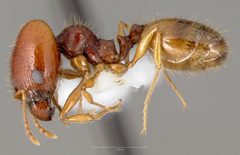
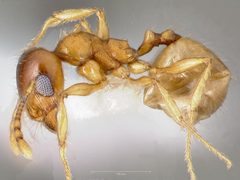
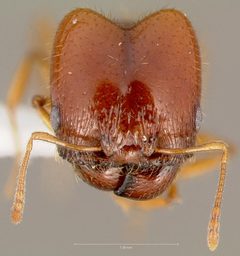
Pronunciation
How to pronounce Pheidole gilvescens: /ˈfaɪdoʊleɪ ɡɪlˈvɛskɛnz/
These audio files are automatically generated. While they are not always 100% accurate, they are a good starting point.
Identification
Pheidole gilvescens can be distinguished from other Pheidole by the combination of its yellowish-tawny coloration and specific morphometric ratios of the and body, though precise diagnostic characters require examination of and original description. Identification to species level within Pheidole typically requires microscopic examination of , particularly the shape of the head, structure, and pilosity patterns. The species is most reliably identified through comparison with the original description (Creighton & Gregg, 1955) and type material.
Images
Appearance
Specific morphological descriptions for P. gilvescens are limited in available literature. As a Pheidole , it exhibits the defining trait of the : pronounced with minor workers having proportionate and major workers (soldiers) possessing greatly enlarged, disproportionately large heads. The specific epithet suggests yellowish or tawny coloration. Minor workers are typically smaller and more numerous in colonies, while major workers use their enlarged heads and for defense, food processing, and nest maintenance.
Distribution
The precise native distribution of Pheidole gilvescens is not clearly documented in available sources. Based on the ' description in 1955 and typical patterns for North American Pheidole, it likely occurs in the southwestern United States or Mexico, though this requires verification against the original description.
Similar Taxa
- Other Pheidole species with major and minor workers is shared across the entire ; specific identification requires detailed morphological examination
More Details
Taxonomic context
Pheidole is one of the most -rich globally, with over 1,000 described species, predominantly in the New World. The genus is renowned for its ecological dominance in many and its extreme . P. gilvescens represents one of many species described in the mid-20th century during intensive taxonomic work on North American ants by William S. Creighton and others.
Sources and further reading
- BugGuide
- GBIF taxonomy match
- iNaturalist taxon
- NCBI Taxonomy
- Catalogue of Life
- Big-headed Ants Are Biggest in Australia Due to Competition
- During Quarantine, an Entomologist Takes a Closer Look at a New Invasive Ant Species
- Fire ant winged reproductives: male and female | Beetles In The Bush
- Hymenoptera | Blog - Part 7
- Bichos Argentinos #2 – Pseudomyrmex sp. | Beetles In The Bush
- Ants in the Nest: A Possible Emerging Pressure on Sea Turtles