
Trachymyrmex smithi
Buren, 1944
Smith's Fungus-farming Ant
Trachymyrmex smithi is a of fungus-farming in the tribe Attini, described by Buren in 1944. Like other members of its , it cultivates symbiotic fungi as a primary food source. The species belongs to a graded genus that is basal to the (Atta and Acromyrmex), representing an intermediate evolutionary stage in the development of advanced fungus-growing . Males of this species exhibit distinctive with reduced size relative to body, a trait noted as characteristic of the genus.
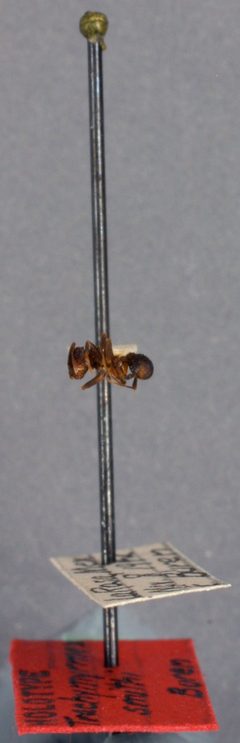

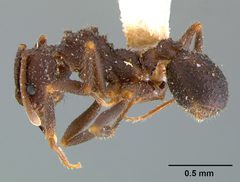
Pronunciation
How to pronounce Trachymyrmex smithi: /ˌtræ.kɪˈmɜr.mɛks ˈsmɪ.θaɪ/
These audio files are automatically generated. While they are not always 100% accurate, they are a good starting point.
Images
Diet
Cultivates symbiotic fungi as primary food source; substrate for fungal gardens consists of plant material collected by .
Behavior
Engages in fungus-farming : collect plant material to cultivate symbiotic fungi in underground gardens; fungal mycelium serves as food for the colony.
Similar Taxa
- Trachymyrmex septentrionalisSimilar size and preferences in eastern North America; distinguished by differences in mesosomal sculpturing and pilosity patterns.
- Atta speciesLarger with more specialized cutting and larger colony sizes; T. smithi represents a more basal, less derived fungus-farming strategy with smaller colonies.
- Acromyrmex speciesMore derived fungus-farming ants with conspicuous external fungal gardens; T. smithi maintains internal gardens and lacks the pronounced spines seen in many Acromyrmex .
More Details
Evolutionary significance
Trachymyrmex represents a graded basal to the , making like T. smithi important for understanding the evolutionary transition from general fungus-farming to specialized leaf-cutting .
Male morphology
Males of T. smithi exhibit reduced size relative to body mass and short antennal scapes, a plesiomorphic condition for male ants that has been independently modified in only a few lineages.
Sources and further reading
- BugGuide
- GBIF taxonomy match
- iNaturalist taxon
- NCBI Taxonomy
- Catalogue of Life
- Encyrtid Holdings | Entomology Research Museum
- Grasshoppers of Colorado
- Grasshoppers of Colorado
- Bembicid Holdings | Entomology Research Museum
- When Mosquitoes Go to Bed for Winter, and How It Can Inform Management
- Fire ant winged reproductives: male and female | Beetles In The Bush