
Lasius nearcticus
Wheeler, 1906
New World Fuzzy Ant
Lasius nearcticus is a of citronella ant in the Formicidae, native to eastern North America. It belongs to a characterized by the production of citronellal, a lemon-scented compound used for alarm communication and defense. The species is part of the Nearctic fauna and has been documented in the eastern United States and parts of Canada.
Pronunciation
How to pronounce Lasius nearcticus: //ˈleɪsiəs niˈɑːrk.tɪ.kəs//
These audio files are automatically generated. While they are not always 100% accurate, they are a good starting point.
Identification
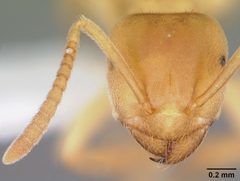
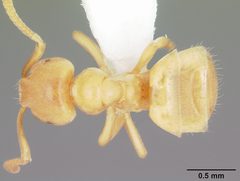
Lasius nearcticus can be distinguished from by its elbowed , narrow petiole (-waist), and forewings larger than hindwings with few prominent . As a citronella ant, it possesses glands near the that produce aromatic citronellal, detectable as a lemon scent when the is disturbed. Winged reproductive forms emerge from the ground to swarm and mate.
Images
Distribution
Eastern United States and parts of Canada; possibly extends to parts of western Canada and the western United States. Specific distribution records include Vermont.
Seasonality
Winged reproductive forms have been observed swarming in late autumn and early winter. One documented observation reports swarming activity in December in the mid-Atlantic region.
Diet
Host Associations
Behavior
When threatened, release citronellal from mandibular glands as an , recruiting nestmates to defend the colony. Glands near the tip produce formic acid, which is directed at as a chemical defense. The is not a wood-destroyer and does not construct damaging tunnels in structures.
Ecological Role
Human Relevance
Lasius nearcticus is frequently mistaken for eastern subterranean termites (Reticulitermes flavipes) when winged forms swarm near homes, causing concern among homeowners. Unlike , this does not damage wooden structures. Its citronellal production and formic acid defense are notable chemical characteristics. The served as a study organism for E. O. Wilson during his early entomological work in Rock Creek Park.
Similar Taxa
- Reticulitermes flavipes (eastern subterranean termite)Winged swarming forms are frequently confused; have bead-like , broad waist, and equal-sized wings
- Lasius alienusHistorically confused taxonomically; L. americanus was placed in synonymy with L. alienus, though they may represent distinct
More Details
Chemical defenses
Lasius nearcticus produces citronellal (lemon-scented compound) from mandibular glands and formic acid from abdominal glands, a dual chemical defense system characteristic of the .
Sources and further reading
- BugGuide
- Wikipedia
- GBIF taxonomy match
- iNaturalist taxon
- NCBI Taxonomy
- Catalogue of Life
- The Ants and Butterflies of Gates Canyon: Quite the Ecosystem | Bug Squad
- UC Davis Alumnus Marek Borowiec: Remembering E. O. Wilson | Bug Squad
- From the Bug of the Week mailbag, termites or ants? Eastern subterranean termites, Reticulitermes flavipes, or Citronella ants, Lasius sp. — Bug of the Week
- Curious isolation: new butterfly species discovered | Blog
- Alternative host-searching strategy in Ghilaromma orientalis
- North America’s itsiest bitsiest longhorned beetle | Beetles In The Bush