
Odontocynips nebulosa
Kieffer, 1910
root gall wasp
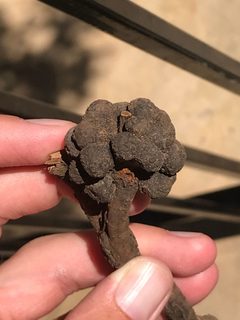
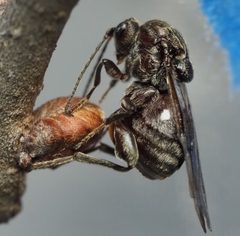
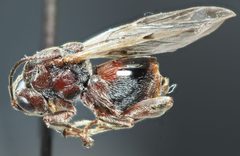
Odontocynips nebulosa is a cynipid that induces large, woody, subterranean galls on oak roots. are small and rarely observed; the galls are the primary sign of its presence. The was long misidentified due to confusion with a different gall-former on oak leaves. It has a two-year and is restricted to the southeastern and central United States.
Pronunciation
How to pronounce Odontocynips nebulosa: /oʊˌdɒntoʊˌsaɪnɪps nɛbjʊˈloʊsə/
These audio files are automatically generated. While they are not always 100% accurate, they are a good starting point.
Identification
Distinguished from similar by its subterranean root galls rather than leaf galls. The common 'mealy oak gall' on leaves was historically misattributed to this but is now known to be induced by an undescribed species. Galls of O. nebulosa are woody, subterranean, and found on oak roots, whereas leaf galls are above-ground and have a mealy-white coating.
Images
Habitat
Tangled roots of young oak shoots growing in dense thickets where humus has accumulated; requires oak as .
Distribution
Southeastern and central United States: Florida to Texas, north to Missouri and Arkansas.
Seasonality
emerge from galls in late winter to early spring (February–March). Galls collected in fall contain pupae in October, with mature adults appearing later that month. may take two years to complete.
Diet
Larvae feed on gall tissue induced in oak roots; the gall serves as both food source and protective structure. do not feed; their diet is unknown.
Host Associations
- Quercus chapmanii - root gall
- Quercus fusiformis - root gall
- Quercus geminata - root gall
- Quercus lyrata - root gall
- Quercus minima - root gall
- Quercus stellata - root gall
- Quercus virginiana - root gall
Life Cycle
Female lays in root tissue of oak. Chemical secretions from the developing larva stimulate the oak to form the gall. Larvae develop within the gall, feeding on the tissue. occurs in fall; emerge February–March. The complete may span two years.
Behavior
Females oviposit into oak root tissue. are rarely observed in the field due to their small size and subterranean association.
Ecological Role
Gall-former that manipulates oak root development; creates and food source for itself and potentially other organisms within the gall chambers.
Human Relevance
None documented. The has no known economic importance or direct interaction with humans.
Similar Taxa
- undescribed cynipid speciesHistorically confused with O. nebulosa; induces the common 'mealy oak gall' on oak leaves rather than subterranean root galls. The leaf gall has a mealy-white coating and occurs above ground, unlike the woody, smooth-barked root galls of O. nebulosa.
Misconceptions
For many years, this was incorrectly associated with a common, mealy-white gall found on oak leaves. This misidentification persisted until L.H. Weld clarified in 1957 that O. nebulosa actually creates large subterranean root galls, and that Bassett's original was likely a mislabeled root gall. The mealy oak leaf gall is now known to be induced by a different, undescribed species.
More Details
Etymology
The specific epithet nebulosa is Latin for 'cloudy,' chosen by Bassett to describe the white, mealy coating on the gall he observed (which was later determined to be a misidentified leaf gall).
Taxonomic history
First described by Homer Franklin Bassett in 1881 as Cynips q. nebulosa. Bassett's description was based on a gall from Florida covered with a 'mealy-white substance,' which he believed was a leaf gall. His were lost and never re-examined. L.H. Weld's 1957 work Cynipid Galls of the Western States clarified the true of the .
Gall characteristics
Fresh galls have smooth, light-colored bark similar to the root. When dry, they become hard and woody. Single galls are 10–13 mm in diameter, but aggregated masses can reach 8 cm. Internal larval cavities measure 6–8 mm in diameter.