
Feron crystallinum
(Bassett, 1900)
Crystalline Gall Wasp
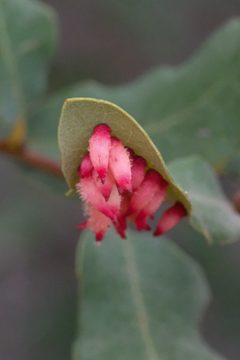
Feron crystallinum is a cynipid gall wasp that induces distinct galls on oak in California. The species exhibits complex , producing different gall morphologies and forms across seasonal cycles. The parthenogenic forms large, pink, hairy galls on leaf undersides, while the bisexual generation produces smaller, less hairy galls. Formerly classified as Andricus crystallinus, this species has been reclassified to the Feron based on phylogenetic relationships.
Pronunciation
How to pronounce Feron crystallinum: /fɛˈrɒn krɪˈstælɪnəm/
These audio files are automatically generated. While they are not always 100% accurate, they are a good starting point.
Identification
Distinguished from other California oak gall wasps by the combination of: large (12–14 mm), pink, densely hairy galls clustered on leaf undersides for the parthenogenic ; smaller, less hairy galls on upper leaf surfaces for the bisexual generation; and the presence of an extended neck on mature large galls. Generational forms differ in coloration: sexual generation females are black, unisexual generation females are reddish, and generation females are chestnut-colored. Exit holes in galls indicate prior and can signal generational change.
Images
Appearance
Galls of the parthenogenic are 12–14 mm high and 7 mm across, pink in color with white, red, or brown hairs, often clustered in masses on leaf undersides. Each gall contains a single larval chamber with an extended neck when mature. The bisexual generation produces smaller galls with shorter hairs on leaf upper surfaces. females of the sexual generation are black and darker than males except for . Unisexual generation females have a reddish tone; generation females are chestnut-colored.
Habitat
Associated with all of oaks (Quercus) in California. Galls occur on both upper and lower leaf surfaces depending on : unisexual generation on undersides, bisexual generation on upper sides.
Distribution
California, USA. Galls have been documented on all oak within the state.
Seasonality
Parthenogenic emerges in late winter. Bisexual generation occurs in spring. Unisexual generation develops during summer and fall.
Host Associations
- Quercus - gall inductionAll oak in California; specific gall location varies by
Life Cycle
Complex heterogonic with alternating . Parthenogenic (unisexual) generation produces all-female offspring that develop in large, pink, hairy galls on leaf undersides during summer and fall, emerging in late winter. Bisexual generation follows in spring, with males and females developing in smaller, less hairy galls on leaf upper surfaces. This generation produces the sexual generation that initiates the next unisexual cycle.
Behavior
Induces gall formation on oak leaves through chemical manipulation of plant tissue. Galls often massed together in dense clusters. Larval development occurs within single-chambered galls; the lower chamber serves as the development site when two chambers are present.
Ecological Role
Forms galls that provide and food resources for and within the oak gall . The contributes to the structural complexity of oak through its distinctive gall formations.
Human Relevance
Studied as a model for understanding gall induction mechanisms and complex evolution in Cynipidae. Documented extensively on iNaturalist with over 2,500 observations, contributing to citizen science and biodiversity monitoring in California.
Similar Taxa
- Other Feron speciesShared characteristics including oak gall association; distinguished by gall , size, hair , and coloration
- Other Cynipidae on California oaksMany induce oak galls; F. crystallinum specifically identified by large pink hairy galls with extended necks on leaf undersides (parthenogenic ) and seasonal gall position differences