
Callirhytis serricornis
(Kinsey, 1922)
kernel flower gall wasp
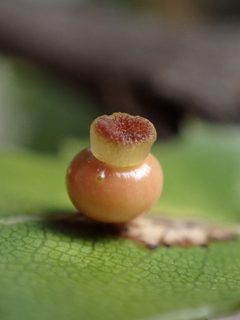
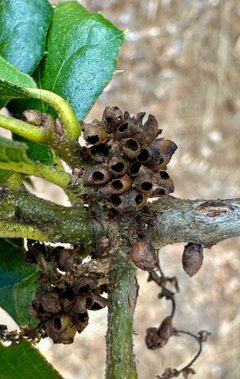
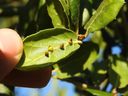
Callirhytis serricornis is a cynipid gall wasp to California that induces distinct bottle- or vase-shaped galls on oak trees. The exhibits alternating with different gall phenotypes: first-generation galls are brown, while second-generation galls are red and green. It is restricted to two oak species in the western United States.
Pronunciation
How to pronounce Callirhytis serricornis: //kæl.ɪˈraɪ.tɪs sɛr.ɪˈkɔr.nɪs//
These audio files are automatically generated. While they are not always 100% accurate, they are a good starting point.
Identification
The bottle- or vase-shaped gall distinguishes this from other California oak gall wasps. First- brown galls and second-generation red-green galls on coast live oak or interior live oak are diagnostic. Differentiation from congeneric Callirhytis species requires examination of gall shape, association, and generation-specific coloration.
Images
Appearance
are small, typical cynipids with reduced wing venation. The specific epithet 'serricornis' refers to serrated . Galls induced by this are distinctive: bottle- or vase-shaped structures attached to oak tissues. First- galls are brown in coloration; second-generation galls display red and green coloration.
Habitat
Restricted to oak woodlands and savannas in California where oaks (Quercus agrifolia and Quercus wislizeni) occur. Galls develop on above-ground tissues of host trees.
Distribution
to California, western United States. Range corresponds to distribution of coast live oak (coastal California) and interior live oak (foothills and interior valleys).
Seasonality
Activity patterns follow the alternating sexual and agamic typical of cynipids with heterogony. Specific seasonal timing not documented in available sources.
Diet
Larvae feed on nutritive tissue within induced galls on oak . do not feed; larvae are the only feeding stage.
Host Associations
- Quercus agrifolia - coast live oak; oviposition site and gall development
- Quercus wislizeni - interior live oak; oviposition site and gall development
Life Cycle
Exhibits heterogonic with alternating sexual and parthenogenetic (agamic) . Two distinct gall morphs correspond to generations: brown galls (first generation) and red-green galls (second generation). Larval development occurs within galls.
Behavior
Females oviposit into oak tissues, inducing gall formation. The manipulates plant development to create a protective structure and food source for larvae.
Ecological Role
Induces structural galls on oak trees, creating microhabitats that may be used by other organisms. Acts as a herbivore with narrow range.
Human Relevance
No documented economic or medical significance. Of interest to students of gall wasp and California oak .
Similar Taxa
- Callirhytis quercuspunctataAlso induces galls on California oaks; differentiated by gall (gouty oak gall vs. bottle/vase shape) and specific associations
- Callirhytis clavulaCongeneric oak gall wasp with different gall structure; produces harder, less succulent galls without latex exudate
More Details
Nomenclatural history
Transferred from Andricus to Callirhytis based on revised generic concepts in Cynipidae. Original description by Kinsey in 1922.
Gall dimorphism
The color and structural differences between first- and second- galls represent one of the more striking examples of generation-specific gall in the .