
Amphibolips spinosa
Ashmead, 1887
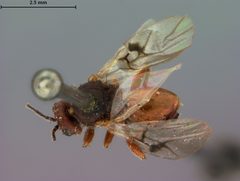
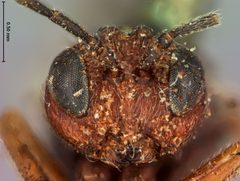
Amphibolips spinosa is a cynipid ( Cynipidae) first described by Ashmead in 1887. Like other members of its , this likely induces galls on oak trees (Quercus spp.), though specific gall and associations remain incompletely documented. The species exhibits alternating sexual and , a trait confirmed through molecular analysis of specimens from Florida and North Carolina. It is known from limited collection records in the southeastern United States.
Pronunciation
How to pronounce Amphibolips spinosa: //æmˈfɪbəˌlɪps spɪˈnoʊsə//
These audio files are automatically generated. While they are not always 100% accurate, they are a good starting point.
Identification
Identification requires examination. The Amphibolips contains numerous , many distinguished by gall characteristics and oak species rather than alone. Molecular data (cytb and ITS2 sequences) have been used to confirm alternating in this species.
Images
Habitat
Associated with oak-dominated in the southeastern United States. Specific microhabitat preferences are not documented.
Distribution
Documented from Florida (Highlands, Manatee, Martin, Walton, Liberty, and Brevard Counties) and North Carolina (Patsy Pond Area and Croatan National Forest, Carteret County).
Host Associations
- Quercus - probable plant for gall induction Amphibolips is primarily associated with oaks; specific for A. spinosa not confirmed in available sources.
Life Cycle
Exhibits alternating with both sexual and forms, as confirmed by molecular analysis. Specific developmental details and gall are not documented.
Ecological Role
As a gall wasp, induces plant tissue modifications (galls) on oaks. These structures provide and food for other organisms including and .
Similar Taxa
- Other Amphibolips speciesNumerous congeneric induce similar oak galls; differentiation often requires gall , specificity, and microscopic examination of .
More Details
Molecular confirmation
Alternating were matched using . Cytb sequences showed 0–1.85% divergence among seven individuals (GenBank OM321616–OM321622); ITS2 sequences were identical across six individuals (GenBank OM331810–OM331815).