
Amphibolips quercusjuglans
(Osten Sacken, 1862)
Acorn Plum Gall Wasp
Amphibolips quercusjuglans, commonly known as the acorn plum gall wasp, is a cynipid gall wasp that induces distinctive plum-like galls on acorns of oak trees (Quercus spp.). The is part of a large radiation of gall-forming specialized on oaks in North America. Its galls are among the most visually striking of oak galls, developing on the cupule or acorn itself rather than on leaves or stems.
Pronunciation
How to pronounce Amphibolips quercusjuglans: //æmˈfɪbəlɪps kwɜːrkəsˈdʒuːglænz//
These audio files are automatically generated. While they are not always 100% accurate, they are a good starting point.
Identification
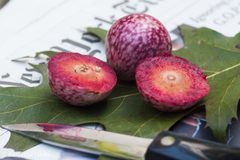
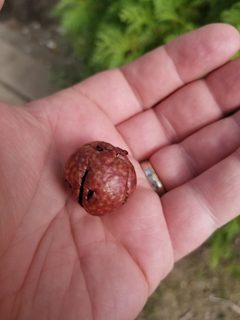
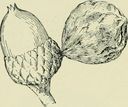
The galls of Amphibolips quercusjuglans are readily identified by their location on acorns and their distinctive appearance: fleshy, ovoid to plum-shaped growths, often pinkish to reddish in color, that replace or envelop the normal acorn. The itself is small, typical of cynipids, but identification usually relies on gall and association rather than wasp characteristics. Similar acorn galls include those of other Amphibolips , but A. quercusjuglans galls tend to be larger, fleshier, and more plum-like than the harder, smaller galls of related species.
Images
Habitat
Found in oak-dominated including deciduous forests, woodlands, savannas, and urban areas where oak occur. The requires mature oaks capable of producing acorns.
Distribution
Eastern and central North America, associated with the range of its oaks. Records span from the northeastern United States west to the Great Plains and south to the Gulf Coast.
Seasonality
emerge from galls in late summer to fall, coinciding with acorn maturation. Galls become visible on developing acorns through the growing season, maturing by late summer.
Host Associations
- Quercus - gall induction oak ; specific gall formed on acorns/cupules
Life Cycle
The involves , a common trait in Cynipidae. The sexual produces the conspicuous plum galls on acorns; emerge, mate, and the resulting agamic generation produces a different gall type (often on buds or leaves) or may have a reduced, poorly known form. The exact alternation pattern for this has not been fully documented.
Behavior
Females oviposit into developing acorns, triggering the formation of large, fleshy galls that provide shelter and nutrition for the developing larva. The gall growth dramatically alters normal acorn development.
Ecological Role
As a gall inducer, the creates for itself and potentially other organisms. The fleshy galls may be consumed by wildlife, though their tannin content may limit palatability. The wasp contributes to the complex of gall-formers that structure interactions between oaks and their associated fauna.
Human Relevance
The galls are conspicuous and often collected out of curiosity. They have minor significance in horticulture, occasionally noticed in landscaping contexts. No economic importance as pest or beneficial has been documented.
Similar Taxa
- Amphibolips quercusostensackeniiAlso forms acorn galls, but produces smaller, harder, more irregular galls rather than the large fleshy plum-like galls of A. quercusjuglans
- Amphibolips quercusspongificaForms spongy acorn galls with a different texture and internal structure
More Details
Gall development
Galls begin as small swellings on young acorns and expand rapidly through the growing season, reaching sizes of 2-4 cm. The exterior is smooth and often pink to reddish, sometimes yellow-green, with a firm but fleshy texture. Internally, the gall contains a single larval chamber with the developing larva surrounded by nutritive tissue.