
Trypoxylon spinosum
Cameron, 1889
Black Reed Wasp
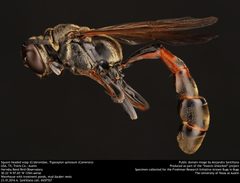
Trypoxylon spinosum is a of solitary spider-hunting in the Crabronidae. As a member of the subgenus Trypargilum, it is among the larger-bodied species in the . Like other Trypoxylon wasps, it nests in pre-existing cavities and provisions with paralyzed spiders for its offspring. The species was described by Cameron in 1889 and is known from Middle and North America.
Pronunciation
How to pronounce Trypoxylon spinosum: /trɪˈpɒksɪlən spɪˈnoʊsəm/
These audio files are automatically generated. While they are not always 100% accurate, they are a good starting point.
Images
Distribution
Middle America and North America. GBIF records indicate presence in both regions.
Diet
Spiders, as is characteristic for the Trypoxylon. Based on congeneric patterns, prey likely includes spiders such as jumping spiders, crab spiders, running spiders, lynx spiders, sac spiders, and possibly orb-weavers.
Life Cycle
Based on congeneric patterns: Females nest in pre-existing cavities such as hollow twigs, borings in dead wood, vacated insect galls, or abandoned mud dauber nests. The cavity is partitioned into individual from back to front. Each cell is provisioned with 5-20 paralyzed spiders, an is laid on the last victim, and the cell is sealed with a mud partition. The larva consumes the spider cache, spins a -specific cocoon, pupates, and emerges as an .
Behavior
Based on congeneric patterns in Trypargilum: Males may participate in nest maintenance by guarding the entrance while females hunt or gather mud, physically blocking and behaving aggressively toward enemies. Males may also assist in placing prey in , cleaning cavities, and building partitions. Males do not sting.
Ecological Role
of spiders. Potential prey source for parasitic and flies that attack Trypoxylon nests.
Similar Taxa
- Trypoxylon politumAlso a large Trypoxylon , but T. politum constructs distinctive free-standing mud nests (pipe organ nests) rather than using pre-existing cavities, and has white markings on the hind tibiae.
- Trypoxylon californicumSimilar size and subgenus (Trypargilum), but identification to requires specimen examination; T. californicum is documented from the southwestern United States.
- Trypoxylon clavatumSimilar size and subgenus (Trypargilum), with overlapping distribution; -level identification requires detailed examination.
More Details
Taxonomic Note
T. spinosum is placed in subgenus Trypargilum, which contains the medium-sized and large of Trypoxylon, distinguished from the smaller species in subgenus Trypoxylon.
Identification Challenges
-level identification within Trypargilum generally requires collection and microscopic examination of specimens; field identification to species is typically not reliable.