
Stizus
Latreille, 1802
sand wasps
Species Guides
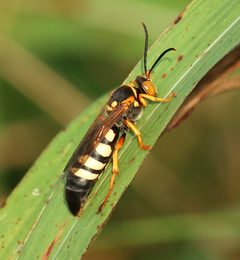
3Stizus is a of sand wasps in the Crabronidae, containing over 100 distributed across Europe, Africa, and North America. These solitary are typically yellow and black, rarely reddish, and reach lengths of about 34 mm. Species nest in sandy soils and provision burrows with prey, primarily grasshoppers, to feed their larvae. Some species form nesting where males defend territories and engage in contest to gain mating access to females.
Pronunciation
How to pronounce Stizus: //ˈstaɪ.zəs//
These audio files are automatically generated. While they are not always 100% accurate, they are a good starting point.
Identification
Distinguished from other sand wasp by combination of size (approximately 34 mm), yellow and black coloration with rare reddish variants, and geographic distribution across Europe, Africa, and North America. Specific identification to level requires examination of detailed morphological characters not covered in general sources.
Images
Appearance
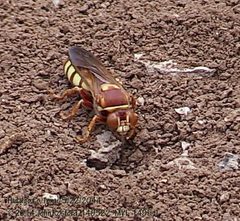
Medium to large , typically reaching about 34 mm in length. Coloration is predominantly yellow and black, with some rarely exhibiting reddish tones. Body form characteristic of sand wasps with adaptations for digging in sandy substrates.
Habitat
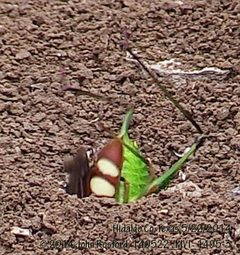
Sandy environments including coastal salt marshes with damp sandy soil, sand dunes, and other loose sandy substrates suitable for excavation of nesting burrows. Nesting may occur in areas of approximately 300 m² or more where soil conditions permit dense clustering of individual nests.
Distribution
Europe, Africa, and North America. Specific study documented from Albufera National Park near Valencia, Spain.
Seasonality
Active from middle of June to end of September in Mediterranean . Two per year with patterns showing protandry at both seasonal and daily levels.
Diet
provision nests with prey to feed larvae. Adult feeding habits not explicitly documented.
Host Associations
- Nemka viduata - Mutillid that parasitizes Stizus continuus nests
Life Cycle
Two per year. may emerge in second generation or enter to emerge the following year. Larvae develop in underground nests provisioned with prey.
Behavior
Males defend territories at nesting and engage in escalated aerial contests involving grappling; contest outcome determined by body size and prior residency status. Territorial males achieve higher mating success than non-territorial males. Males guard holes to obtain access to virgin females. Females show social attraction to active nests, producing clumped nest patterns. Emergence occurs in daily clumped patterns suggesting synchrony from same nests. Females nest close to nearest conspecific nest rather than near their own emergence hole, indicating conspecific nests serve as key cue for nest establishment. Males do not prefer to establish territories close to their natal nest.
Ecological Role
of grasshoppers. Nesting activities may contribute to soil aeration in sandy .
Human Relevance
Attracted to fermenting baits (molasses/beer mixtures) used in trapping, occasionally captured incidentally in such traps. No significant documented economic impact or direct human utility.
Similar Taxa
More Details
Nesting aggregation structure
In Stizus continuus, holes are not important cues for nest establishment; instead, females use active nests as the key cue, resulting in clumped nest patterns. distances from natal nests do not differ from random simulations, and body size does not affect patterns.
Protandry patterns
Both seasonal and daily protandry (earlier male ) has been documented, with males emerging before females and establishing territories at nesting .
Sources and further reading
- BugGuide
- Wikipedia
- GBIF taxonomy match
- iNaturalist taxon
- NCBI Taxonomy
- Catalogue of Life
- Bembicid Holdings | Entomology Research Museum
- Disteniidae | Beetles In The Bush
- insects | Beetles In The Bush | Page 10
- Territorial dynamics and contest behaviour in the solitary wasp Stizus continuus (Hymenoptera: Apoidea: Crabronidae)
- Emergence and dispersal relative to natal nest in the digger wasp Stizus continuus (Hymenoptera: Crabronidae)
- Description of the Mature Larva of Nemka viduata (Pallas) (Hymenoptera: Multillidae: Mutillinae), a Parasitoid of Stizus continuus (Klug) (Hymenoptera: Crabronidae: Bemibicinae)