
Hoplisoides semipunctatus
(Taschenberg, 1875)
sand wasp
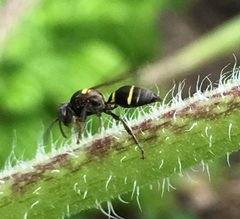
Hoplisoides semipunctatus is a of sand wasp in the Crabronidae. It is native to South America, with records from Brazil (Bahia and Santa Catarina). The Hoplisoides comprises approximately 18 species in North America and is distributed globally except Australia. Members of this genus are solitary that typically hunt treehoppers (Membracidae) as prey for their larvae.
Pronunciation
How to pronounce Hoplisoides semipunctatus: //ˌhɒplɪˈsɔɪdiːz ˌsɛmɪˌpʌŋkˈteɪtəs//
These audio files are automatically generated. While they are not always 100% accurate, they are a good starting point.
Identification
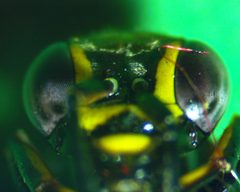
The specific epithet 'semipunctatus' suggests the may bear distinctive punctation or spotting patterns, possibly on the wings or body. Within the Hoplisoides, species are generally characterized by spotted or patterned wings. Definitive identification requires examination of morphological features including wing venation, body punctation patterns, and genitalia. The species can be distinguished from congeneric North American species such as H. nebulosus by its South American distribution and presumably distinct punctation patterns, though detailed comparative descriptions are lacking in available sources.
Images
Habitat
Based on -level characteristics, Hoplisoides typically inhabit sandy environments where females excavate burrows for nesting. Available sources do not specify particular preferences for H. semipunctatus beyond its occurrence in South America.
Distribution
South America. Specific records exist from Brazil (Bahia, Santa Catarina). GBIF data also indicate presence in the contiguous United States, though this may represent misidentifications or vagrant records requiring verification.
Diet
Based on documented of , particularly North American , H. semipunctatus likely hunts treehoppers (Membracidae) as prey for larval provisions. However, this inference has not been confirmed for this specific species.
Life Cycle
Based on -level documentation from H. nebulosus: females dig burrows in sand at 45-70° angles to depths of approximately 6 cm, constructing terminal 9-11 mm long. Cells are provisioned with paralyzed prey (treehoppers), with 10-15 individuals per cell on average. A single is laid on the final prey item. Whether H. semipunctatus follows this pattern specifically is unknown.
Ecological Role
As a member of Crabronidae, this likely functions as a of herbivorous insects, potentially contributing to of treehoppers. Specific ecological studies for this species are not available.
Similar Taxa
- Hoplisoides nebulosusA well-documented North American with similar and , but distinguished by geographic range (eastern United States versus South America) and presumably different wing and body punctation patterns.
- Hoplisoides spilopterusAnother North American with spotted wings; distinguished by distribution and subtle morphological differences in wing pattern.
More Details
Taxonomic note
Hoplisoides was historically classified in Bembicidae (or Nyssonidae), but modern treatments place it in Crabronidae. The was described by Taschenberg in 1875.
Data gaps
No published studies specifically address the , , or of H. semipunctatus. Most information about the derives from studies of North American , particularly H. nebulosus.