
Hylaeus punctatus
(Brullé, 1832)
Punctate Masked Bee, Punctate Spatulate-Masked Bee
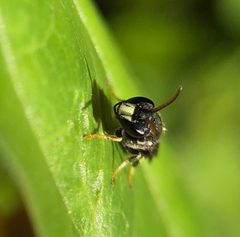
Hylaeus punctatus is a of masked in the Colletidae, native to North America. Like other members of its , it is nearly hairless and -like in appearance, with distinctive facial markings. This solitary bee nests in pre-existing cavities such as hollow stems or twigs, lining with a glandular secretion. It is a that transports pollen and nectar internally rather than on body hairs.
Pronunciation
How to pronounce Hylaeus punctatus: /hɪˈliːəs pʌŋkˈtætəs/
These audio files are automatically generated. While they are not always 100% accurate, they are a good starting point.
Identification
Distinguished from other Hylaeus by punctate body markings. Separated from by (branched) body hairs visible at 60x magnification, though this requires microscopic examination. Distinguished from other bees by nearly hairless, wasp-like appearance and internal pollen transport. Differs from Hylaeus modestus and Hylaeus basalis by specific facial marking patterns and body punctation.
Images
Appearance
Nearly hairless, slender body with -like appearance. Small size typical of the Hylaeus. Distinctive punctate (dotted) markings on body, referenced in the name. in facial markings: females with yellow, white, or ivory markings on inner margin of ; males with entire colored yellow or white.
Habitat
Uses pre-existing cavities in hollow stems, twigs, or abandoned galls for nesting. Requires bare or minimally vegetated ground for access to nest sites. Associated with diverse flowering vegetation in both natural and urban settings.
Distribution
Recorded from North America; specific records include the United States. Distribution details beyond North America are sparse; one database indicates presence in Belgium and Brussels-Capital Region, though this may reflect data quality issues rather than established range.
Diet
feed on nectar from flowers. Larvae consume a mixture of pollen and nectar provisioned by females. Specific floral associations for this are not documented; -level studies indicate foraging with potential preference for Rosaceae and Asteraceae when available.
Life Cycle
Solitary nesting: each female constructs and provisions her own nest. Females collect pollen and nectar internally, storing them in a crop, then regurgitating into . Cells are lined with a natural polymer secretion from abdominal glands. One larva per cell. Developmental timing specific to this is not documented.
Behavior
Solitary nesting . Females use pre-existing cavities rather than excavating nests. Pollen and nectar transport occurs via internal storage (crop) rather than external scopae or corbiculae. Readily uses artificial nest boxes with small diameter holes. Males may congregate near nesting sites.
Ecological Role
of flowering plants. Contributes to pollination services in both natural and urban . As a forager, likely supports of diverse plant . Serves as prey or for unspecified and .
Human Relevance
Potential beneficiary of -friendly gardening practices. Can be supported by providing artificial nest boxes (bundles of hollow stems or drilled wood blocks with small holes, elevated and protected from rain). Part of the native fauna that supports urban biodiversity.
Similar Taxa
- Hylaeus modestusSimilar -like appearance and facial markings; distinguished by specific punctation patterns and facial marking details
- Hylaeus basalisOverlaps in range and general ; separated by facial marking configuration and body punctation
- Small wasps (Crabronidae, Vespidae)Nearly identical appearance to naked ; separated by microscopic examination of hairs (bees) versus simple hairs ()
More Details
Nesting Biology
Like other Hylaeus , females lack specialized pollen-carrying structures and instead transport pollen and nectar in an internal crop. This correlates with reduced body hair and -like appearance.
Conservation Status
Not among the Hylaeus listed as threatened or endangered. Seven Hawaiian Hylaeus species are critically imperiled, but H. punctatus is not among them.
Sources and further reading
- BugGuide
- Wikipedia
- GBIF taxonomy match
- iNaturalist taxon
- NCBI Taxonomy
- Catalogue of Life
- Looking for Cheap Urban Real Estate | Bug Squad
- Bug Eric: Wasp Wednesday: Not Wasp VI
- Bug Eric: A Beautiful Place to "Bee"
- Some Varieties of Annual Flowers Have a Place in Pollinator-Friendly Gardens
- Bug Eric: Wasp Wednesday: Anacrabro ocellatus
- National Meadows Day 2022 in Northern Ireland - Buglife Blog - Buglife