
Hylaeus mesillae cressoni
(Cockerell, 1907)
Cresson's Masked Bee
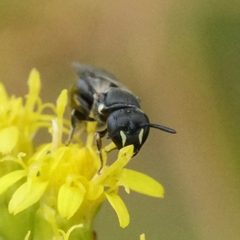
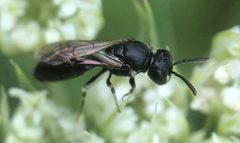
Hylaeus mesillae cressoni is a of masked in the Colletidae. Like other members of the Hylaeus, it is nearly hairless and often mistaken for a small . The is distributed in North America and Middle America. As a solitary bee, each female constructs her own nest in pre-existing cavities such as hollow stems or twigs.
Pronunciation
How to pronounce Hylaeus mesillae cressoni: //hɪˈliːəs mɛˈsɪlaɪ ˈkrɛsəni//
These audio files are automatically generated. While they are not always 100% accurate, they are a good starting point.
Identification
Distinguished from by (branched) hairs, though this requires magnification to observe. Separated from other Hylaeus by specific facial marking patterns and geographic distribution. Often initially mistaken for wasps due to hairless appearance.
Images
Appearance
Nearly hairless body with a -like appearance. Females have yellow, white, or ivory markings on the inner margin of each ; males have the entire colored yellow or white. The body lacks the dense branched hairs typical of most bees, making it appear smooth and shiny.
Habitat
Uses pre-existing cavities in hollow stems, twigs, or abandoned insect burrows for nesting. Found in varied environments where such nesting substrates and floral resources are available.
Distribution
Recorded from North America and Middle America. GBIF records indicate presence in both regions.
Diet
feed on nectar. Females collect pollen and nectar, storing nectar in an internal crop and regurgitating it at the nest; pollen is also collected though specific plants for this are not documented.
Life Cycle
Solitary nesting. Female constructs in pre-existing cavities, lining them with glandular secretions that form a natural polymer (plastic-like substance). Each cell receives provisioned food and a single . Larval development occurs within sealed cells.
Behavior
Solitary; females work alone to provision nests. Visits flowers for nectar and pollen. Will use artificial boxes with small diameter holes. Males often congregate near nesting sites.
Ecological Role
. Contributes to pollination of flowering plants visited for nectar and pollen collection.
Human Relevance
May benefit from provision of artificial nesting structures ( boxes with small holes, hollow stems). Potential in gardens and natural areas.
Similar Taxa
- Hylaeus modestusAnother North American masked with similar -like appearance and use; distinguished by specific facial markings and distribution
- Other Hylaeus speciesShare hairless appearance and solitary cavity-nesting ; require examination of facial markings and genitalia for definitive identification
- Small wasps (Crabronidae, Vespidae)Similar size and hairless appearance, but have simple unbranched hairs (visible at 60x magnification) and different wing venation
Misconceptions
Frequently mistaken for due to nearly hairless body; this has led to some Hylaeus originally being described as wasps by scientists.
More Details
Nesting biology
Like other Hylaeus, this lines nest with a glandular secretion that forms a natural polymer, protecting stored food from spoilage.
Sources and further reading
- BugGuide
- GBIF taxonomy match
- iNaturalist taxon
- NCBI Taxonomy
- Looking for Cheap Urban Real Estate | Bug Squad
- Bug Eric: Wasp Wednesday: Not Wasp VI
- Bug Eric: A Beautiful Place to "Bee"
- Some Varieties of Annual Flowers Have a Place in Pollinator-Friendly Gardens
- Bug Eric: More Drama at the Bee Block
- Bug Eric: Wasp Wednesday: Anacrabro ocellatus