
Hylaeus leptocephalus
(Morawitz, 1870)
Slender-faced Masked Bee
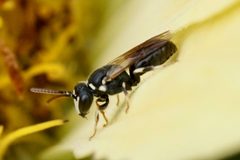
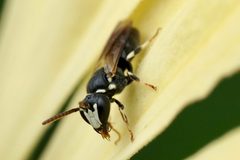
Hylaeus leptocephalus is a small solitary in the Colletidae, commonly known as the Slender-faced Masked Bee. Native to the Palearctic region, it has been established in North America since 1912. Like other masked bees, it is nearly hairless and transports pollen and nectar internally rather than on body hairs. The nests in pre-existing cavities such as hollow stems and twigs.
Pronunciation
How to pronounce Hylaeus leptocephalus: /hɪˈliːəs lɛptoʊˈsɛfələs/
These audio files are automatically generated. While they are not always 100% accurate, they are a good starting point.
Identification
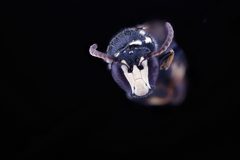
Nearly hairless body with -like appearance. Males have the entire colored yellow or white; females have yellow, white, or ivory markings limited to the inner margin of each . Distinguished from similar Hylaeus by subtle facial and structural characters requiring expert examination. (feather-like) hairs visible at 60x magnification separate it from true wasps, which have simple unbranched hairs.
Images
Distribution
Native to the Palearctic region (including Belgium and the Brussels-Capital Region). Introduced to North America, where it has been present since 1912.
Ecological Role
As a member of Hylaeus, likely serves as a , though specific pollen foraging preferences for this have not been documented.
Similar Taxa
- Hylaeus modestusSimilar small size, nearly hairless appearance, and yellow facial markings; distinguished by subtle morphological differences in facial structure and genitalia requiring expert identification.
- Hylaeus basalisShares yellow-faced bee and -like appearance; males of both have extensive yellow facial markings, but differ in distribution and specific facial pattern details.
- Hylaeus confususOverlaps in distribution and general appearance; both are small, sparsely hairy bees with pale facial markings, requiring close examination for definitive separation.
Sources and further reading
- BugGuide
- Wikipedia
- GBIF taxonomy match
- iNaturalist taxon
- NCBI Taxonomy
- Catalogue of Life
- Looking for Cheap Urban Real Estate | Bug Squad
- Bug Eric: Wasp Wednesday: Not Wasp VI
- Bug Eric: A Beautiful Place to "Bee"
- Some Varieties of Annual Flowers Have a Place in Pollinator-Friendly Gardens
- Bug Eric: Wasp Wednesday: Anacrabro ocellatus
- National Meadows Day 2022 in Northern Ireland - Buglife Blog - Buglife