
Hylaeus floridanus
(Robertson, 1893)
Florida Masked Bee
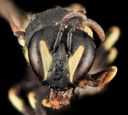
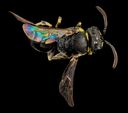
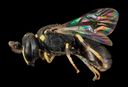
Hylaeus floridanus is a of masked (yellow-faced bee) in the Colletidae. Like other members of its , it is nearly hairless and -like in appearance, transporting pollen and nectar internally in a crop rather than externally on body hairs. Females nest in pre-existing cavities such as hollow stems or twigs, lining with a secreted polymer. The species is native to Florida and the southeastern United States.
Pronunciation
How to pronounce Hylaeus floridanus: /hɪˈlaɪəs flɔːrɪˈdeɪnəs/
These audio files are automatically generated. While they are not always 100% accurate, they are a good starting point.
Identification
Distinguished from by (branched) body hairs visible at 60× magnification or greater, though this requires microscopic examination. Separated from other Hylaeus by geographic range and subtle morphological characters. The nearly hairless, slender body and facial markings are key field characters. Males may be confused with wasps due to pale, colored and lack of obvious pollen-carrying structures.
Images
Habitat
Associated with areas providing pre-existing nesting cavities: hollow stems, twigs with pithy centers, or abandoned insect burrows. Found in natural and semi-natural in Florida, including coastal and subtropical environments.
Distribution
Native to southeastern United States, with records from Florida. Distribution records indicate presence in North America; specific range appears centered on Florida based on epithet and distribution patterns.
Diet
feed on nectar. Larvae provisioned with regurgitated nectar and pollen stored in nest . Specific floral associations for this are not documented; members are generally considered with some species showing preferences for Rosaceae or Asteraceae when available.
Life Cycle
Solitary nesting: each female constructs and provisions her own nest. Nests established in pre-existing cavities (hollow stems, twigs, abandoned burrows). lined with secreted organic polymer (natural plastic) to prevent spoilage of stored provisions. Single larva develops per cell, feeding on stored pollen-nectar mass.
Behavior
Females forage for nectar and pollen, which are carried internally and regurgitated into nest . Males may aggregate near nesting sites. Will utilize artificial nest boxes (bundled straws, drilled blocks) if provided. Non-aggressive; lacks functional stinger.
Ecological Role
, though contribution to specific plant is poorly documented due to internal pollen transport. Provides food source for nest and . Nesting in pre-existing cavities may facilitate nutrient cycling in dead plant material.
Human Relevance
Potential beneficiary of native conservation efforts and artificial nest box programs. Like other native bees, may contribute to pollination of wild plants and crops, though specific documentation for this is lacking. Not known to be a pest or nuisance species.
Similar Taxa
- Hylaeus basalisAnother North American yellow-faced bee with similar -like appearance and facial markings; distinguished by geographic distribution and subtle morphological characters
- Hylaeus bisinuatusWestern U.S. with similar ; distinguished by range (western vs. southeastern) and documented specialization on White Sweetclover
- Small wasps (various Vespidae)Readily mistaken in field due to shared hairless, slender body form; distinguished by microscopic examination of hairs (bees) vs. simple hairs (), and by nesting
More Details
Conservation context
The Hylaeus has experienced significant declines in some regions. Seven Hawaiian Hylaeus are considered critically imperiled and possibly extinct, primarily due to on , larvae, and pupae. While H. floridanus itself has no documented conservation status, this highlights vulnerability of the genus to disturbance and .
Nesting biology
The -lining secretion produced by females is a remarkable example of natural polymer production. This organic plastic creates a waterproof, antimicrobial barrier that preserves larval food stores, analogous to cellophane or plaster in human materials—hence the 'plasterer bees' for the Colletidae.
Sources and further reading
- BugGuide
- GBIF taxonomy match
- iNaturalist taxon
- Catalogue of Life
- Looking for Cheap Urban Real Estate | Bug Squad
- Bugs in Orange and Black, Part II: A spooky southern predator heads north in a warming world – Florida predatory stink bug, Euthyrhynchus floridanus — Bug of the Week
- Northern hospitality for the Florida predatory stink bug, Euthyrhynchus floridanus, and wax scales, Ceroplastes spp. — Bug of the Week
- Bug Eric: Wasp Wednesday: Not Wasp VI
- Bug Eric: A Beautiful Place to "Bee"
- Amped-Up Ants: Caterpillars' Sugary Treats Earn Carpenter Ant Care