
Hylaeus euxanthus
(Cockerell, 1910)
Yellow-collared Masked Bee
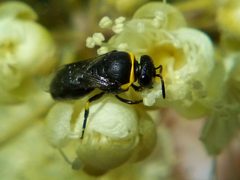
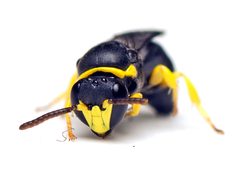
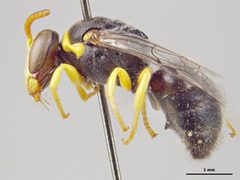
A small, nearly hairless in the Colletidae, native to Australia and introduced to Argentina. First described by Cockerell in 1910, it was originally named Prosopis xanthopoda but renamed due to preoccupation. It belongs to the subgenus Gnathoprosopis and exhibits typical masked bee characteristics including reduced pilosity and internal pollen transport.
Pronunciation
How to pronounce Hylaeus euxanthus: /hɪˈlaɪ.əs juːˈzænθəs/
These audio files are automatically generated. While they are not always 100% accurate, they are a good starting point.
Identification
As a member of Hylaeus, this is nearly hairless with a -like appearance. Identification to species level requires examination of facial markings and other subtle morphological characters. Females have yellow, white, or ivory markings on the inner margin of each , while males have the entire colored yellow or white. The specific epithet 'euxanthus' (Greek: 'true yellow') suggests distinctive yellow coloration, likely on the collar or face. Definitive identification requires taxonomic examination.
Images
Distribution
Native to Australia. Introduced to Argentina, where established have been confirmed through specimens reared from trap nests and photographic records.
Diet
Pollen analysis of in Argentina revealed a preference for Myrtaceae .
Behavior
Nests in pre-existing cavities including hollow stems and twigs. Females ingest nectar and store it in a crop, then regurgitate to provision . Individual cells are lined with a glandular secretion forming a natural polymer (cellophane-like lining).
Ecological Role
, with demonstrated preference for Myrtaceae in its introduced range. Serves as for Coelopencyrtus hylaei (Encyrtidae).
Human Relevance
Documented as an in Argentina, detected through citizen science records on iNaturalist. Its introduction highlights the role of public platforms in tracking non-native species.
Similar Taxa
- Hylaeus modestusAnother small, nearly hairless masked with similar -like appearance; distinguished by distribution (North America) and specific facial markings
- Other Hylaeus speciesNearly 900 worldwide, many with similar reduced pilosity; require examination of genitalia and other subtle characters for definitive identification
Sources and further reading
- BugGuide
- Wikipedia
- GBIF taxonomy match
- iNaturalist taxon
- NCBI Taxonomy
- Catalogue of Life
- Looking for Cheap Urban Real Estate | Bug Squad
- Bug Eric: Wasp Wednesday: Not Wasp VI
- Bug Eric: A Beautiful Place to "Bee"
- Some Varieties of Annual Flowers Have a Place in Pollinator-Friendly Gardens
- Bug Eric: Wasp Wednesday: Anacrabro ocellatus
- National Meadows Day 2022 in Northern Ireland - Buglife Blog - Buglife
- The Australian bee Hylaeus ( Gnathoprosopis ) euxanthus (Hymenoptera: Colletidae) in Argentina: Nesting biology, floral preferences and parasitism