
Caupolicana electa
(Cresson, 1878)
Caupolicana electa is a of plasterer bee in the Colletidae. It is one of the largest bees in its , with females reaching up to 22 mm in body length. The species is native to North America and is active primarily in spring. Like other members of Caupolicana, it constructs nest lined with a cellophane-like secretion produced from its .

Pronunciation
How to pronounce Caupolicana electa: /kaʊpɒˈlɪkənə ɪˈlɛktə/
These audio files are automatically generated. While they are not always 100% accurate, they are a good starting point.
Identification
Distinguished from other Caupolicana by its large size—females exceed 20 mm, while most are under 15 mm. The basitarsus of the hind leg in females is notably broad and flattened compared to C. yarrowi. Males can be separated from C. fulvicollis by the of facial and antennal proportions. The combination of large body size, black coloration with pale abdominal bands, and spring period separates it from superficially similar anthophorine bees.
Images
Appearance
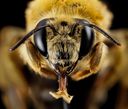
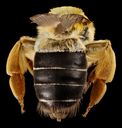
A large, robust with females measuring 18–22 mm and males slightly smaller. The body is densely hairy with a velvety texture. Coloration is predominantly black with pale, often yellowish or whitish, hair bands on the . The hind legs of females are modified for pollen collection with dense scopal hairs. Males have longer and may show more extensive pale markings on the . The wings are dark with a subtle iridescent sheen.
Habitat
Open, sandy or loamy soils in coastal and interior regions. Associated with scrubland, chaparral edges, and open woodland clearings. Requires exposed ground for nesting.
Distribution
Western North America, from southern California northward through Oregon and into southwestern Washington. Records extend eastward into Nevada, Arizona, and New Mexico.
Seasonality
Spring-active; fly primarily from March through May, with peak activity in April. timing varies with elevation and latitude.
Diet
feed on nectar and collect pollen from a variety of flowering plants. Specific plant associations have been documented with Camissonia, Oenothera (Onagraceae), and other spring-blooming herbs.
Life Cycle
Solitary nesting . Females excavate burrows in sandy soil and construct individual lined with a transparent, cellophane-like secretion. Each cell is provisioned with a pollen-nectar mass and receives a single . Larvae develop within the sealed cells, with occurring in summer and emerging the following spring. No evidence of social or multiple per year.
Behavior
Females are solitary ground-nesters, excavating burrows with multiple . Nest architecture includes a waterproof, transparent cell lining secreted from the —a diagnostic trait of the Colletidae. Males patrol nesting areas and vegetation patches seeking females. Both sexes are foragers with rapid, direct patterns.
Ecological Role
of spring-blooming native plants, particularly in early-successional and open . Its large size enables effective pollen transfer for plant with deeper floral tubes. As a ground-nesting , it contributes to soil aeration and nutrient cycling in its nesting .
Human Relevance
Occasional visitor to gardens with native plantings, though rarely abundant enough to be agriculturally significant. Not known to sting readily; females possess stings but are non-aggressive. Provides ecological value as a native in restoration contexts.
Similar Taxa
- Caupolicana yarrowiOverlaps in range and ; smaller (females 12–16 mm), with narrower hind basitarsus and more extensive reddish coloration on legs.
- Caupolicana fulvicollisSimilar size range; males distinguished by sparser facial and different antennal proportions. Females show more extensive pale hair on the .
- Anthophora spp.Similar large, robust, fast-flying bees with pale abdominal bands; separated by two submarginal in forewing (three in Caupolicana) and different nesting .