
Colletes wilmattae
Cockerell, 1904
cellophane bee, polyester bee, plasterer bee
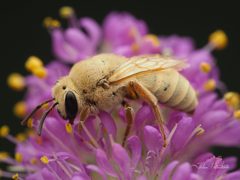
Colletes wilmattae is a solitary in the Colletidae, first described by Theodore Cockerell in 1904. Like other members of its , it is commonly known as a cellophane bee, polyester bee, or plasterer bee due to the distinctive cellophane-like lining females create in their underground . The species is native to North America, occurring in both the United States and Canada. As a solitary ground-nesting bee, it plays a role in early-season pollination.
Pronunciation
How to pronounce Colletes wilmattae: //kəˈliːtiːz wɪlˈmæt.iː//
These audio files are automatically generated. While they are not always 100% accurate, they are a good starting point.
Identification
Colletes are difficult to distinguish from one another without microscopic examination. Where multiple Colletes species occur in the same area, specimens must be examined microscopically for definitive species-level identification. General characters for the include: a forked or bifurcated tongue (visible when extended); forewing with three submarginal beneath the marginal cell; second recurrent distinctly S-shaped (sinuous) rather than straight; and a -shaped in -on view. Males have longer than females and lack the scopa (pollen-collecting brush) on the hind legs.
Images
Distribution
Native to North America; recorded from the United States and Canada. Specific preferences for C. wilmattae are not documented in available sources, though typically nest in sandy soils with thin vegetation in sunny locations.
Ecological Role
As a solitary , likely contributes to pollination of early-season flowering plants. Members of the Colletes are foragers (polylectic) or (oligolectic) depending on , but specific pollen and nectar sources for C. wilmattae are not documented.
Similar Taxa
- Colletes inaequalisA closely related vernal plasterer bee with similar ground-nesting and spring ; requires microscopic examination to distinguish
- Andrena spp.Mining bees that resemble Colletes in general appearance and ground-nesting habit; distinguished by straight second recurrent in forewing and rounder shape
- Halictus spp. and Lasioglossum spp.Larger sweat bees that can resemble Colletes; differ in wing venation and lack the distinctive cellophane -lining
More Details
Taxonomic note
The epithet 'wilmattae' honors an individual named Wilmatt, though the specific etymology is not detailed in available sources. The species was described by Theodore Dru Alison Cockerell, a prolific early 20th century entomologist who described numerous species.
Sources and further reading
- BugGuide
- Wikipedia
- GBIF taxonomy match
- iNaturalist taxon
- NCBI Taxonomy
- Catalogue of Life
- An introduction to the Northern Colletes mining bee - Buglife Blog - Buglife
- Boisterous bee-havior of ground nesting bees, Colletes thoracicus — Bug of the Week
- Spring sunshine heralds the appearance of plasterer bees: Colletes — Bug of the Week
- Spring arrives and with it, delightful Plasterer bees: Colletes spp. — Bug of the Week
- Spring sunshine heralds the appearance of plasterer bees, Colletes — Bug of the Week
- Bug Eric: Polyester Bees