
Omalus aeneus
(Fabricius, 1787)
Cuckoo Wasp
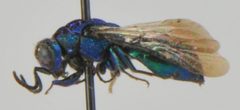
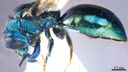
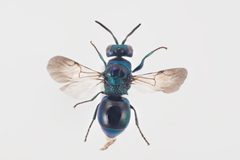
Omalus aeneus is a small, metallic cuckoo wasp in the Chrysididae. Females reach 4.5–5.4 mm in body length, males 4.4–5 mm. The exhibits striking metallic coloration ranging from blue, green, and purple to nearly black or golden, with greenish-blue and legs. This cleptoparasitic has two or more annually in southern Europe and exploits a remarkable indirect strategy: females oviposit into living aphids, which are subsequently captured by -hunting crabronid wasps and transported to their nests, where the cuckoo wasp larva develops.
Pronunciation
How to pronounce Omalus aeneus: /ˈoʊ.mə.ləs ˈiː.ni.əs/
These audio files are automatically generated. While they are not always 100% accurate, they are a good starting point.
Identification
Distinguished from similar cuckoo wasps by: shallow breast punctation (not deep); antennal not thickened in middle; three-toothed ; three-toothed claws; and the distinct notch on the hind margin of the third abdominal tergite. Metallic coloration is highly variable (blue, green, purple, black, or golden), so structural characters are more reliable than color. Similar to Omalus biaccinctus but differs in specific abdominal tergite .
Images
Habitat
Associated with supporting its and their prey. Found in areas where solitary crabronid wasps (Pemphredon, Passaloecus, Psenulus, Stigmus) nest, including woodlands, gardens, and anthropogenic environments with suitable nesting substrates for hosts.
Distribution
Palearctic: Europe (Finland, Germany, Italy, Switzerland), East Palaearctic realm (China, Taiwan, Japan), Near East, North Africa. : introduced and established in North America. GBIF records confirm presence in Belgium, Denmark, Norway, and Sweden.
Seasonality
Two or more annually in southern Europe; activity patterns elsewhere not fully documented but likely multivoltine in warmer climates.
Host Associations
- Pemphredon rufiger - nesting provisions nests with aphids
- Passaloecus tenuis - nesting provisions nests with aphids
- Passaloecus eremita - nesting provisions nests with aphids
- Passaloecus cuspidatus - nesting provisions nests with aphids
- Psenulus pallipes - nesting provisions nests with aphids
- Psenulus atratus - nesting provisions nests with aphids
- Stigmus solskyi - nesting provisions nests with aphids
Life Cycle
Cleptoparasitic development. Female oviposits into living aphids. When -hunting crabronid (Crabronidae) capture these aphids as prey for their own larvae, the cuckoo wasp is transported into the nest. The cuckoo wasp larva hatches, kills the host larva, and consumes the aphid provisions. Two or more per year in southern Europe.
Behavior
Females have been observed laying inside living aphids, exploiting the foraging of -hunting crabronid to gain access to nests. This indirect strategy allows the cuckoo wasp to avoid directly entering host nests. rarely visit flowers; more commonly found at aphid colonies and extrafloral .
Ecological Role
(kleptoparasite) of solitary crabronid . Indirectly regulates of -hunting wasps and influences aphid colony dynamics through its exploitation of aphid prey.
Human Relevance
No direct economic importance; of scientific interest for its sophisticated indirect strategy. May be encountered by naturalists and entomologists studying -associated insect .
Similar Taxa
- Omalus biaccinctusSimilar size and metallic coloration; both exploit -hunting crabronids through indirect . Distinguished by abdominal tergite and punctation patterns.
- Pseudomalus auratusAnother introduced cuckoo wasp with metallic coloration, but with emerald / and ruby red ; differs in associations (uses cavity-nesting bees and rather than -hunting crabronids).
Misconceptions
Previously assumed to directly parasitize nests; now known to use indirect strategy via oviposition. The was historically confused with related due to variable metallic coloration.
More Details
Subspecies
Four recognized: Omalus aeneus aeneus (Fabricius, 1787); Omalus aeneus chevrieri Tournier, 1877; Omalus aeneus japonicus (Bischoff, 1910); Omalus aeneus puncticollis Mocsáry, 1887.
Indirect Parasitism Mechanism
This exemplifies an extraordinary evolutionary strategy: rather than directly entering nests, females oviposit into living aphids. When crabronid capture these aphids as prey, the cuckoo wasp is inadvertently transported to the host nest. This was only recently fully appreciated through observations and photographic documentation, representing a significant advance in understanding chrysidid .
Sources and further reading
- BugGuide
- Wikipedia
- GBIF taxonomy match
- iNaturalist taxon
- NCBI Taxonomy
- Encyrtid Holdings | Entomology Research Museum
- Bug Eric: November 2011
- Bug Eric: Wasp Wednesday: Pseudomalus auratus
- Learning the Insect Lingo While Working Abroad
- Bug Eric: January 2016
- Nomenclatural changes in Phymatodes | Beetles In The Bush