
Hedychridium dimidiatum
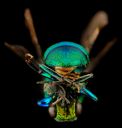
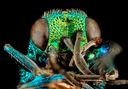
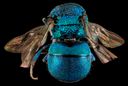
Hedychridium dimidiatum is a of cuckoo wasp in the Chrysididae. These small, brilliantly metallic are nest of predatory solitary wasps, particularly beewolves in the Philanthus. The species has been documented as a suspected parasite of Philanthus gibbosus in North America. Like other chrysidids, females enter nests to lay , and when threatened can roll into a tight ball where their dense, sculptured protects them from stings and bites.
Pronunciation
How to pronounce Hedychridium dimidiatum: /ˌhɛdɪˈkrɪdiəm ˌdɪmɪˈdeɪtəm/
These audio files are automatically generated. While they are not always 100% accurate, they are a good starting point.
Identification
Members of the Hedychridium are among the most brilliantly colored of the chrysidids, displaying bright metallic blues, greens, and reds. Identification to level requires close examination of sculpturing and other microscopic characters. The species name 'dimidiatum' (meaning 'divided in half') may refer to a distinctive color pattern, though specific diagnostic features for this species are not documented in available sources.
Images
Distribution
Documented from North America, with specific records from the United States. The Hedychridium has a broad distribution including the Western Hemisphere from North America through South America.
Host Associations
- Philanthus gibbosus - suspected Cuckoo wasp suspected of parasitizing the larval of this beewolf
Life Cycle
As a chrysidid , the involves females entering the nests of wasps to lay . The larva develops as a consuming the host larva or the prey provisioned for it. occurs within the host nest or in a cocoon.
Behavior
Females are nest that actively seek out nests. When detected by host , they can roll into a tight defensive ball; their dense, sculptured is impervious to the stings and bites of irate hosts. This defensive is characteristic of the Chrysididae.
Ecological Role
Similar Taxa
- HedychrydiumThe source text contains a likely misspelling 'Hedychrydium dimidiatum' when referring to this as a of beewolves; this appears to be the same as Hedychridium dimidiatum
- Other ChrysididaeAll cuckoo wasps share the characteristic metallic coloration, compact body form, and ability to roll into a defensive ball; microscopic examination of sculpturing patterns is required for -level identification
More Details
Taxonomic note
The was referenced as 'Hedychrydium dimidiatum' in the primary source ( Eric blog, August 2011), which appears to be a misspelling of Hedychridium. The Hedychridium is well-established in the Chrysididae.
Conservation status
No conservation assessment is available for this . The Hedychridium contains many undescribed species, and the group is understudied globally.
Sources and further reading
- BugGuide
- GBIF taxonomy match
- iNaturalist taxon
- Searching for the Most Unusual Gift? | Bug Squad
- Bug Eric: Wasp Wednesday: Beewolves
- The ants, bees and wasps of Canada, Alaska and Greenland – a checklist of 9250 species | Blog
- Bug Eric: March 2011
- Bug Eric: August 2011
- Journal of Hymenoptera Research | Blog - Part 3