
Amisega kahlii
(Ashmead, 1902)
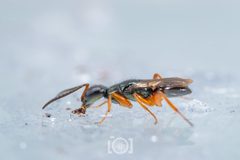
Amisega kahlii is a of cuckoo wasp in the Amiseginae. Members of this are kleptoparasitic, laying in the nests of other insects. The species has been recorded from scattered localities across the eastern and central United States.
Pronunciation
How to pronounce Amisega kahlii: //æmɪˈsiːɡə ˈkɑːli.aɪ//
These audio files are automatically generated. While they are not always 100% accurate, they are a good starting point.
Identification
Amiseginae are distinguished from other chrysidid by their elongated, slender body form and reduced wing venation. Within Amisega, -level identification requires examination of microscopic characters including male genitalia and specific punctation patterns on the . Separation from the related Loboscelidia may be necessary in some regions.
Images
Appearance
As a member of Chrysididae, likely exhibits the 's characteristic metallic coloration, though specific color pattern for this is not documented in available sources. Amiseginae are generally small, slender with reduced wing venation compared to other chrysidid .
Habitat
associations are poorly documented. Records span multiple ecoregions including the southwestern desert (Arizona), Great Plains (Kansas), upper Midwest (Minnesota), and eastern deciduous forest (Maryland, North Carolina), suggesting broad ecological or association with widely distributed .
Distribution
Documented from Arizona, Kansas, Minnesota, Maryland, and North Carolina in the United States. The scattered, disjunct distribution pattern may reflect limited sampling effort or association with patchily distributed .
Host Associations
- Mantodea oothecae - probable Amiseginae are known to parasitize () of praying mantises; this association is inferred from -level but has not been directly confirmed for A. kahlii
Ecological Role
As a probable kleptoparasite of , may function as a regulator of praying mantises. The Amiseginae represents one of the few lineages specialized on mantid .
Similar Taxa
- Other Amisega speciesRequire microscopic examination for reliable separation; A. kahlii is distinguished by male genitalic characters and specific punctation patterns.
- LoboscelidiaRelated amisegine with similar body form; distinguished by antennal structure and wing venation details.
More Details
Taxonomic history
Originally described as Mesitiopterus kahlii by Ashmead in 1902, later transferred to Amisega. The Amisega is among the least studied chrysidid genera in North America.