
Bethylinae
Genus Guides
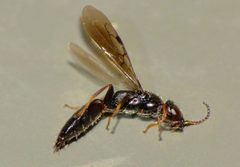
2Bethylinae is a of small, stout-bodied within the Bethylidae. Members are characterized by reduced wing venation and a compact, often humpbacked appearance. The subfamily contains numerous that parasitize the larvae of beetles and , with females typically searching for concealed in plant material or soil. Bethylinae is distinguished from other bethylid subfamilies by specific morphological features of the and mesosoma.
Pronunciation
How to pronounce Bethylinae: //bɛˈθɪlaɪniː//
These audio files are automatically generated. While they are not always 100% accurate, they are a good starting point.
Identification
Bethylinae can be distinguished from Epyrinae by the reduced wing venation (Epyrinae typically have more complete venation with additional closed ). Distinguished from Scleroderminae by the compact body form and pronotal structure—Scleroderminae often have more elongate bodies and different antennal segmentation. The combination of reduced wing cells, compact humpbacked body, and low antennal insertion separates Bethylinae from most other . Within Bethylidae, the mesosomal structure and antennal club shape are critical characters.
Images
Habitat
Found in diverse terrestrial where occur, including forests, woodlands, agricultural fields, and disturbed areas. Associated with dead wood, leaf litter, soil, and herbaceous vegetation where host larvae are concealed. Often collected by sifting litter, beating vegetation, or rearing from host material.
Distribution
distribution, with recorded from all major biogeographic regions including Nearctic, Palearctic, Neotropical, Afrotropical, Oriental, and Australasian realms. Diversity appears highest in tropical and subtropical regions.
Seasonality
activity patterns vary by region and ; in temperate zones, active primarily from late spring through autumn. Some species may be active year-round in tropical . Peak often coincides with larval availability.
Diet
Larvae are obligate of concealed insect larvae, primarily Coleoptera (beetles) and Lepidoptera (). feeding habits poorly documented; likely feed on nectar, honeydew, or fluids in some .
Host Associations
- Coleoptera - Larvae of various , particularly those in concealed
- Lepidoptera - Larvae of , especially those in leaf rolls, stems, or soil
Life Cycle
Development is holometabolous with complete . Females locate concealed larvae, sting to paralyze or kill them, and deposit externally on or near the host. Larvae feed ectoparasitically on the host, typically consuming it entirely. occurs in the host or nearby; some spin cocoons. Multiple per year likely in favorable conditions; stage varies by species and climate.
Behavior
Females are active searchers, using to detect vibrations or chemical cues in concealed microhabitates. Host location involves probing plant material, soil, or wood with the antennae. Some may exhibit maternal care, remaining with developing offspring. Males are often short-lived and may be attracted to female-emitted . capability varies; some species are brachypterous or , particularly females in certain lineages.
Ecological Role
Important agents of concealed herbivorous larvae, particularly in forest and agricultural . Contribute to of and pests. Serve as food for larger (hyperparasitism) and . Role in nutrient cycling through consumption in soil and litter .
Human Relevance
Similar Taxa
- EpyrinaeSimilar compact body form but distinguished by more complete wing venation with additional closed ; antennal structure also differs
- ScleroderminaeRelated bethylid with more elongate body, different pronotal structure, and often different preferences
- ChrysididaeSimilar small size and reduced wing venation in some groups, but chrysidids typically have metallic coloration and are rather than of concealed larvae
More Details
Taxonomic complexity
Bethylinae contains numerous (including Bethylus, Goniozus, and Pristocera) with substantial alpha-taxonomic challenges. Many descriptions are old and based on limited material, complicating identification. Molecular phylogenetic studies have begun to clarify relationships but remain incomplete.
Sexual dimorphism
Marked is common, with females typically larger, winged or wingless, and possessing modified . Males are often fully winged with antennae, and may be rarely collected or unknown for many .