
Perilampus canadensis
Crawford, 1914
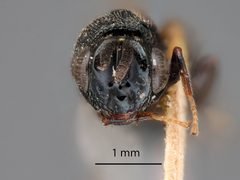
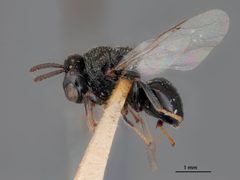
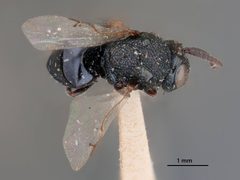
Perilampus canadensis is a small parasitic wasp in the Perilampidae, first described by Crawford in 1914. Like other perilampids, it is likely a hyperparasitoid, with larvae that develop as of other parasitic insects. The has been recorded from Louisiana, Maryland, Minnesota, New York, and Ontario, suggesting a broad distribution across eastern and central North America. Members of this are typically metallic green or blue in color and range from 1.3 to 5.5 millimeters in length.
Pronunciation
How to pronounce Perilampus canadensis: //ˌpɛrɪˈlæmpəs ˌkænəˈdɛnsɪs//
These audio files are automatically generated. While they are not always 100% accurate, they are a good starting point.
Identification
Perilampus canadensis can be recognized as a perilampid by its compact body, short strongly elbowed , and shaped like a triangle or inverted pyramid. These features distinguish perilampids from similar-looking cuckoo wasps ( Chrysididae), which have oval or rounded abdomens without sharp corners. Many perilampids exhibit brilliant metallic green or blue coloration, though some are wholly black.
Images
Distribution
Recorded from Louisiana, Maryland, Minnesota, New York, and Ontario.
Ecological Role
As a member of the Perilampidae, this likely functions as a hyperparasitoid in . Perilampid larvae typically parasitize other parasitic insects such as tachinid flies, ichneumon wasps, or braconid wasps that are themselves living as inside caterpillars or other insect larvae. This places them at the fourth in some .
Similar Taxa
- ChrysididaeCuckoo wasps are similar in size and sometimes found in similar situations, but have oval or rounded without the triangular shape characteristic of perilampids, and lack the short, strongly elbowed .
Sources and further reading
- BugGuide
- GBIF taxonomy match
- iNaturalist taxon
- Catalogue of Life
- Bug Eric: Spider Sunday: Red Velvet Jumper
- Bug Eric: True Bug Tuesday: Mirid plant bug
- Bug Eric: Wasp Wednesday: Perilampid Wasps
- Snake Road | Beetles In The Bush
- Melanthiaceae | Beetles In The Bush
- Vampire Moths Suck the Blood of Vertebrates, Including Humans