
Bruchophagus
Ashmead, 1888
seed chalcid, gall wasp
Bruchophagus is a of chalcid wasps in the Eurytomidae. within this genus are primarily seed-feeders, developing in the seeds of plants in the Fabaceae family, though some species form galls on citrus or other . The genus has a distribution and includes economically significant pests such as the alfalfa (B. roddi) and citrus gall wasp (B. fellis). Recent phylogenomic studies indicate the genus is .
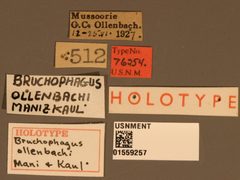
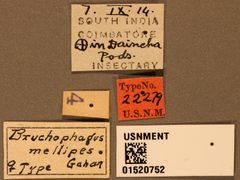
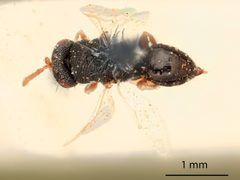
Pronunciation
How to pronounce Bruchophagus: /bruːˈkɒfəɡəs/
These audio files are automatically generated. While they are not always 100% accurate, they are a good starting point.
Identification
Members of Bruchophagus can be distinguished from other Eurytomidae by their association with seeds or galls of specific plants. -level identification typically requires examination of morphological characters such as body proportions, mesosoma shape in lateral view, and wing venation patterns. For example, B. ayadi differs from B. platypterus by having a roundish and a very gibbous, almost globular mesosoma in lateral view.
Images
Habitat
Found in diverse environments including agricultural systems, riparian forests, forest edges, and secondary vegetation. are tightly associated with their plants, which include alfalfa fields, citrus orchards, acacia woodlands, and areas with native or leguminous plants.
Distribution
. Documented from Europe (Austria, Bulgaria, France, Germany, Hungary, Poland, Romania, Spain, Sweden, Turkey, Ukraine), Asia (India, Iraq, Israel, Iran, Mongolia, China, Uzbekistan), Africa (Canary Islands, South Africa), Australasia (Australia, New Zealand, Papua New Guinea), Pacific Islands (Hawaii), North America (Canada, USA), and South America (Argentina, Brazil, Chile, Peru).
Diet
Larvae feed on seeds of Fabaceae or form galls in plant tissues. Specific feeding habits vary by : B. roddi consumes alfalfa seeds, B. acaciae and related species feed on Acacia seeds, B. ayadi develops in Melilotus officinalis seeds, B. caraganae infests Caragana seeds, B. robiniae is associated with Robinia seeds, and B. fellis and B. muli form galls on citrus twigs and fruit respectively.
Host Associations
- Medicago sativa - seed B. roddi, major pest of alfalfa
- Astragalus membranaceus - seed B. huonchili
- Acacia - seed Multiple including B. acaciae, B. orarius, B. interior; associated with subgenus Phyllodineae
- Melilotus officinalis - seed B. ayadi
- Caragana - seed B. caraganae
- Robinia pseudoacacia - seed B. robiniae
- Lotus corniculatus - seed B. platypterus
- Citrus aurantifolia - gall inducerB. muli, galls fruit
- Citrus - gall inducerB. fellis, galls twigs of lemon, orange, grapefruit
- Inga marginata - Bruchophagus sp. parasitizes seed Colopterus truncatus
Life Cycle
Development occurs within seeds or galls of plants. Larvae feed on seed tissues or gall parenchyma. takes place within the seed or gall. is asynchronous in some , with emergence patterns varying between host and .
Behavior
Females use olfactory cues to locate . In B. roddi, females fly toward volatile compounds from alfalfa seed pods and flowers, including octan-3-ol, (E)-β-farnesene, 1-octen-3-ol, α-copaene, γ-muurolene, and (E)-2-hexenal. At close range, they orient to seed pod and leaf extracts. Similar chemically-mediated host location has been documented in B. huonchili, which responds to cis-β-ocimene, hexyl acetate, hexanal, decanal, and β-caryophyllene from Astragalus membranaceus pods.
Ecological Role
Seed that reduce seed production of plants, potentially limiting plant growth and spread. Some act as of other seed-feeding insects. In their native ranges, they contribute to regulation of plant populations; in introduced ranges, they may serve as agents for plants such as Australian acacias in South Africa.
Human Relevance
Several are significant agricultural pests. B. roddi is a major pest of alfalfa seed production, causing substantial yield losses. B. huonchili threatens Astragalus membranaceus seed yield and quality. B. fellis is a pest of citrus, forming galls on twigs. Conversely, some species are under investigation as agents for Australian acacias in South Africa. Understanding volatile-mediated location has enabled development of monitoring tools using synthetic attractants.
Similar Taxa
- Other EurytomidaeBruchophagus are distinguished by their specific association with legume seeds or citrus galls; other eurytomids may parasitize different including other insects or plant parts
- Other seed-feeding chalcids plant association is the primary distinguishing feature; Bruchophagus is specifically associated with Fabaceae seeds or citrus, whereas other seed chalcids may target different plant
More Details
Taxonomic Status
The Bruchophagus is currently considered based on recent phylogenomic studies, indicating that taxonomic revision may be needed.
Biological Control Potential
Several Australian Bruchophagus that feed on Acacia seeds are being investigated as potential agents to limit the invasiveness of Australian acacias in South Africa. These species are not -specific at the species level but appear restricted to the subgenus Phyllodineae.
Sources and further reading
- BugGuide
- Wikipedia
- GBIF taxonomy match
- iNaturalist taxon
- NCBI Taxonomy
- Catalogue of Life
- Bruchophagus roddi . [Distribution map].
- Distribution and Host Record of Bruchophagus Robiniae (Hymenoptera, Eurytomidae) in Turkey
- RESPONSE OF THE ALFALFA SEED CHALCID, BRUCHOPHAGUS RODDI, TO ALFALFA VOLATILES
- Biology of the trefoil seed chalcid,Bruchophagus kolobovaeFedoseeva (Hymenoptera: Eurytomidae)
- Laboratory studies of the biology of the alfalfa seed chalcid,Bruchophagus roddiGuss. (Hymenoptera: Eurytomidae)
- Exploiting Asynchronous Host-Parasitoid Emergence Distributions to Optimise Insecticide Applications and Protect Beneficial Insects– a Case Study Using the Citrus Gall Wasp Bruchophagus Fellis (Hymenoptera: Eurytomidae)
- Emergence patterns of adult citrus gall wasp, Bruchophagus fellis (Hymenoptera: Eurytomidae), and its key parasitoids in southern Australia
- Notes on the Life History and Habits of a Chalcid, Bruchophagus caraganae (Nik.), (Hymenoptera: Chalcididae), Infesting Seeds of Caragana
- Bruchophagus muli sp. n. (Hymenoptera: Eurytomidae), a wasp which galls the fruit of lime in Papua New Guinea
- Electroantennogram response of alfalfa seed chalcid,Bruchophagus roddi (Hymenoptera: Eurytomidae) to host- and nonhost-plant volatiles
- Tritrophic interaction": first record of Colopterus truncatus (Coleoptera: nitidulidae) and its parasitoid Bruchophagus sp. on Inga marginata SEEDS
- The description of a new Bruchophagus species (Hymenoptera, Chalcidoidea, Eurytomidae) developing in seeds of Melilotus officinalis (L.) Descr. (Fabaceae) in Iran
- Seed‐feeding species of Bruchophagus Ashmead (Hymenoptera: Eurytomidae) associated with native Australian acacias that are invasive in South Africa, with the description of two new species
- Exploiting asynchronous host-parasitoid emergence distributions to optimise insecticide applications and protect beneficial insects– a case study using the citrus gall wasp Bruchophagus fellis (Hymenoptera: Eurytomidae)
- Deciphering the Chemical Fingerprint of Astragalus membranaceus: Volatile Components Attractive to Bruchophagus huonchili Wasps