
Tamarixia radiata
(Waterston, 1922)
Asian citrus psyllid parasitoid
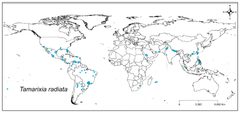
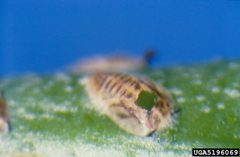
Tamarixia radiata is a minute in the Eulophidae, native to northwestern India and Pakistan. It is an obligate ectoparasitoid of the Asian citrus psyllid (Diaphorina citri), the of Huanglongbing (). The has been introduced to multiple countries for , including the United States, Brazil, Mexico, and several Caribbean and Pacific islands. A single female can eliminate up to 500 nymphs through combined and host feeding.
Pronunciation
How to pronounce Tamarixia radiata: //ˌtæməˈɹɪksiə ˌɹædiˈɑːtə//
These audio files are automatically generated. While they are not always 100% accurate, they are a good starting point.
Images
Appearance
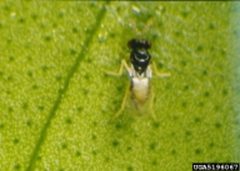
are small black measuring 0.92–1.04 mm in length. The is slightly wider than long with widely separated that are red in newly emerged adults. Wings are transparent with pale yellow . is pronounced: males have one and a half times longer than females, with long and slightly curved setae, while female antennae bear short setae. Males are slightly smaller than females, with smaller wings and darker . The female ovipositor barely protrudes. In both sexes, the head and are shiny black; the and lateral portions of gastric segments are black, while the vent and an dorsal patch on the are pale to yellowish. Legs are off-white.
Sources and further reading
- BugGuide
- Wikipedia
- GBIF taxonomy match
- NCBI Taxonomy
- Publications | Entomology Research Museum
- Wasps Used to Combat Citrus Greening Disease are Unlikely to Threaten Non-target Insects
- Biological Control in Brazil is Used on an Area that is Larger than Belgium
- Heliconiidae | Beetles In The Bush
- an Asian citrus psyllid parasitoid Tamarixia radiata (Waterston) (Insecta: Hymenoptera: Eulophidae)
- Lethal and Sublethal Effects of Insecticides Used on Citrus, on the Ectoparasitoid Tamarixia radiata
- Effects of Ladybeetle, Harmonia axyridis, Foraging Trails on Behavior of Tamarixia radiata
- Toxicity of pesticides to Tamarixia radiata, a parasitoid of the Asian citrus psyllid
- Efectos de insecticidas botánicos comerciales en Tamarixia radiata, un ectoparasitoide de Diaphorina citri
- Genetic Diversity of Tamarixia radiata Populations and Their Associated Endosymbiont Wolbachia Species from China
- Oviposition behaviour of Tamarixia radiata : effects of host density and exposure time
- Primer reporte de Tamarixia radiata (Waterston) (HYMENOPTERA: EULOPHIDAE) en el departamento de Caldas, Colombia
- Seletividade de inseticidas recomendados para a produção integrada de citros sobre o parasitoide Tamarixia radiata (Waterston, 1922) (Hymenoptera: Eulophidae)
- Reduced Parasitism of Diaphorina citri (Hemiptera: Liviidae) by Tamarixia Radiata (Hymenoptera: Eulophidae) at Increasing Parasitoid:Host Ratios
- Toxicity of Organosilicone Adjuvants and Selected Pesticides to the Asian Citrus Psyllid (Hemiptera: Psyllidae) and Its Parasitoid Tamarixia radiata (Hymenoptera: Eulophidae)
- Otimização da criação de Diaphorina citri Kuwayama, 1908 (Hemiptera: Liviidae) e de Tamarixia radiata (Waterston, 1922) (Hymenoptera: Eulophidae), visando a produção em larga escala do parasitoide e avaliação do seu estab
- Functional response and implications for mass rearing ofTamarixia radiata(Hymenoptera: Eulophidae), parasitoid of the citrus greening disease vectorDiaphorina citri(Hemiptera: Psyllidae)
- Introduction, pre and post release monitoring of the parasitoidTamarixia radiataPakistan strain (Hymenoptera: Eulophidae) againstDiaphorina citri(Hemiptera: Psyllidae) in Puerto Rico
- Can parasitism by Tamarixia radiata (Hymenoptera: Eulophidae) affect the movement and oviposition behavior of Diaphorina citri (Hemiptera: Psyllidae)?