
Pseudochalcura gibbosa
(Provancher, 1881)
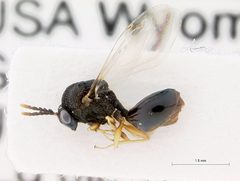
Pseudochalcura gibbosa is a of parasitic wasp in the Eucharitidae, first described by Provancher in 1881. It belongs to a family of known for their highly specialized of ants. The species has been recorded across multiple provinces in Canada, though detailed biological information remains limited in published sources.
Pronunciation
How to pronounce Pseudochalcura gibbosa: //ˌsjuːdoʊˈkælkjʊrə ɡɪˈboʊsə//
These audio files are automatically generated. While they are not always 100% accurate, they are a good starting point.
Images
Distribution
Canada: Alberta, British Columbia, Manitoba, New Brunswick.
Host Associations
- Ants (Formicidae) - Eucharitidae are obligate of larvae, though specific records for P. gibbosa are not documented in available sources.
Life Cycle
Eucharitid wasps have a highly derived involving phoretic transport by ants. Females lay on or near plants; larvae hatch and attach to passing ants, which carry them to the nest where they parasitize larvae. However, specific details for P. gibbosa have not been published.
Ecological Role
As a of ants, this likely functions as a regulator of colonies. Eucharitidae are among the most specialized ant known, representing a unique evolutionary within Hymenoptera.
Similar Taxa
- Other Pseudochalcura species-level characters including body form and antennal structure would be required for separation; specific diagnostic features for P. gibbosa are not detailed in available sources.
- Other Eucharitidae genera-level characters such as the structure of the mesosoma and metasoma, and details of wing venation, are used to distinguish within Eucharitidae.
More Details
Taxonomic note
The was originally described by Provancher in 1881, indicating it has been recognized in entomological literature for over 140 years, yet it remains poorly studied biologically.
Data limitations
The 18 iNaturalist observations and scattered Canadian museum records constitute most of the accessible occurrence data for this . No peer-reviewed studies specifically addressing its , , or relationships have been identified in the sources provided.