
Xylocopa strandi
Dusmet y Alonso, 1924
Strand's Carpenter Bee
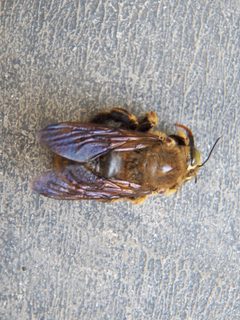
Xylocopa strandi is a of large in the Apidae, distributed across Central America and North America. As a member of the Xylocopa, it exhibits the characteristic traits of carpenter bees: large size, robust build, and wood-nesting . The species was described by Dusmet y Alonso in 1924. Like other Xylocopa species, it is a solitary with incipient social tendencies, though detailed studies specific to this species are limited.
Pronunciation
How to pronounce Xylocopa strandi: //zaɪˈlɒkəpə ˈstrændaɪ//
These audio files are automatically generated. While they are not always 100% accurate, they are a good starting point.
Identification
Specific identification features for Xylocopa strandi are not well documented in available sources. As a Xylocopa , it likely shares the -wide characteristics of large body size (15-25 mm), robust , and relatively hairless, shiny that distinguishes carpenter bees from the hairy-abdomened bumble bees (Bombus). in facial markings may occur, with males potentially showing light-colored patches on the , though this requires confirmation for this specific species.
Images
Distribution
Central America and North America. Specific country records are not detailed in available sources, but the range spans from southern North America through Central America based on distribution records.
Similar Taxa
- Xylocopa virginicaOverlaps in eastern North American range; both are large carpenter bees with similar overall , though X. virginica is well-studied with confirmed male facial markings and nesting that may differ from X. strandi.
- Xylocopa sonorinaAnother North American ; X. sonorina (Valley carpenter bee) shows strong with males being golden-brown and females solid black, which may help distinguish it from X. strandi if similar patterns exist.
- Bombus spp.Bumble bees are frequently mistaken for carpenter bees due to similar size and coloration; distinguished by densely hairy (carpenter bees have shiny, relatively hairless abdomens) and smaller relative to in bumble bees.
More Details
Research Context
While Xylocopa strandi itself has not been specifically studied, research on congeneric (X. sonorina, X. tabaniformis, X. virginica) has revealed that carpenter bees distinctive gut bacterial similar to eusocial bees like honey bees and bumble bees, despite lacking advanced sociality. This suggests that long lifespan and limited social interactions, rather than eusociality, may maintain these microbiomes. Whether X. strandi shares this characteristic is unknown but plausible given phylogenetic relatedness.
Sources and further reading
- BugGuide
- Wikipedia
- GBIF taxonomy match
- iNaturalist taxon
- NCBI Taxonomy
- Catalogue of Life
- Innovative Research by RSPIB Scholar: Surprising Find About Carpenter Bees | Bug Squad
- Sold on the Salvia | Bug Squad
- Bumble bee, carpenter bee, he bee, she bee: Bombus spp., Xylocopa spp. — Bug of the Week
- Bumble bee, carpenter bee, redux: Bombus spp. and Xylocopa spp. — Bug of the Week
- Carpenter bees defending territories: Large carpenter bee, Xylocopa virginica — Bug of the Week
- Guardians of the galleries: Male Eastern Carpenter Bees, Xylocopa virginica — Bug of the Week