
Ceratina dupla
Say, 1837
doubled ceratina
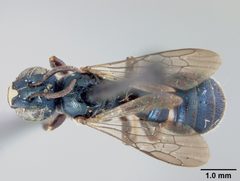
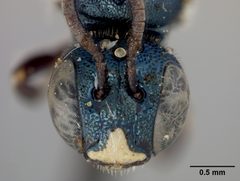
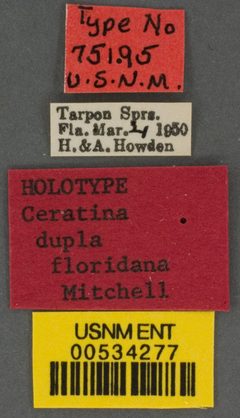
Ceratina dupla is a small carpenter bee in the Apidae. It occurs in the eastern half of North America and parts of Central America. The was formerly confused with Ceratina floridana and Ceratina mikmaqi until molecular analyses revealed significant genetic differences. It is a solitary that nests in the pith of dead twigs and has been documented visiting multiple flower species in prairie .
Pronunciation
How to pronounce Ceratina dupla: /sɛrətəna djupla/
These audio files are automatically generated. While they are not always 100% accurate, they are a good starting point.
Identification
Ceratina dupla can be distinguished from the similar Ceratina mikmaqi by five fixed differences and an average sequence divergence of 1.86% based on barcode analysis. It nests earlier in the season than C. mikmaqi and C. calcarata. Morphological differences from related require expert examination; genetic analysis provides definitive separation from C. mikmaqi and C. floridana.
Images
Habitat
Occurs in prairie and open . Nests in the pith of dead twigs, particularly in Fuller's teasel (Dipsacus fullonum).
Distribution
Eastern half of North America; also recorded in Central America. Present in southern Ontario, Canada, and the United States.
Seasonality
Active earlier in the season than related C. mikmaqi and C. calcarata. Sometimes produces a second in late July to early August.
Host Associations
- Dipsacus fullonum - nesting substrateprimary nesting substrate in pith of dead stems
- Rubus - nesting substrateoccasionally used, though more typical of C. calcarata
Life Cycle
Produces one , sometimes two. Second brood occurs in late July to early August when conditions permit.
Behavior
Constructs linear nests in the pith of dead twigs. Exhibits variable flower patch preferences depending on flower : visits isolated flowers or shows no preference when foraging on Penstemon digitalis or Monarda fistulosa, but prefers denser patches when visiting Eryngium yuccifolium.
Ecological Role
Contributes to crop pollination services as part of wild . Represents a smaller, less social bee that may avoid competition with larger social bees by utilizing isolated flowers.
Human Relevance
Contributes to agricultural pollination services, though economic valuation studies indicate that a small subset of common wild provide the majority of crop pollination. Subject of conservation concern as part of declining wild bee diversity.
Similar Taxa
- Ceratina mikmaqiFormerly confused with C. dupla; distinguished by (1.86% sequence divergence, five fixed differences), later nesting , and different primary nesting substrate preferences
- Ceratina floridanaFormerly confused with C. dupla; distinguished through molecular analyses demonstrating significant genetic differences
- Ceratina calcarataCo-occurs in eastern North America; nests later than C. dupla and typically uses Rubus stems rather than Dipsacus
Sources and further reading
- BugGuide
- Wikipedia
- GBIF taxonomy match
- iNaturalist taxon
- NCBI Taxonomy
- Catalogue of Life
- Just inTime for Pollinator Week | Bug Squad
- Do Pollinators Prefer Dense Flower Patches? Sometimes Yes, Sometimes No
- BitB Best of 2009 | Beetles In The Bush
- Nesting biology and DNA barcode analysis of Ceratina dupla and C. mikmaqi, and comparisons with C. calcarata (Hymenoptera: Apidae: Xylocopinae)