
Ceratina acantha
Provancher, 1895
small carpenter bee
Ceratina acantha is a of small in the Apidae, native to Central and North America. It is one of numerous Ceratina species that contribute to wild pollination services, though like most small carpenter bees, it is not among the crop-pollinating species. These bees are solitary or weakly social and nest in pre-existing cavities in dead plant material. The species has been documented in studies examining responses to flower , showing flexible foraging patterns compared to larger social bees.
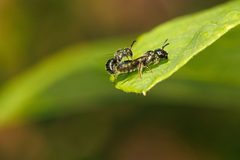
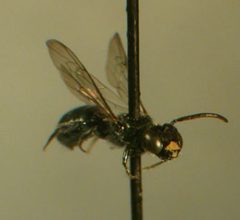
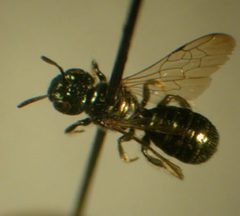
Pronunciation
How to pronounce Ceratina acantha: //ˌsɛr.əˈtaɪ.nə əˈkæn.θə//
These audio files are automatically generated. While they are not always 100% accurate, they are a good starting point.
Images
Habitat
Nests in dead twigs and stems. Associated with prairie and open where suitable nesting substrates and floral resources are available.
Distribution
Found in Central America and North America. Distribution records indicate presence in Middle America and North America.
Diet
Feeds on nectar and pollen from flowers. Observed visiting Penstemon digitalis, Monarda fistulosa, and Eryngium yuccifolium in a restored Ohio prairie study.
Life Cycle
Nests in dead twigs. As with other Ceratina , females construct linear nests in pithy stems, provisioning with pollen and nectar for larval development.
Behavior
Exhibits flexible foraging with respect to flower patch . Unlike bumble bees, does not consistently prefer dense flower patches; visitation patterns vary by flower , with some observations showing preference for isolated flowers or no density preference.
Ecological Role
Contributes to pollination of wild and crop plants. Part of the diverse wild that provides pollination services; however, like most Ceratina , is not among the small subset of crop that provide the majority of economic pollination value.
Human Relevance
Contributes to wild pollination services, though not a primary target for managed pollination. Research on this and related Ceratina species informs understanding of how diverse bee coexist and partition floral resources.
Similar Taxa
- Ceratina spp. (other small carpenter bees)Shared characteristics including small size, metallic coloration, and nesting in dead stems; specific identification requires examination of morphological details not provided in available sources.
- Bombus spp. (bumble bees)Co-occurring that differ in being larger, social, and showing consistent preference for dense flower patches; C. acantha is smaller, solitary or weakly social, and shows more flexible foraging patterns.
More Details
Flower density research
A study in Environmental Entomology found that Ceratina was the only group significantly visiting all three focal flower (Penstemon digitalis, Monarda fistulosa, Eryngium yuccifolium), yet showed different responses to patch for each. This suggests that flower identity and potentially competing pollinators influence patch-size preference in this .
Sources and further reading
- BugGuide
- Wikipedia
- GBIF taxonomy match
- iNaturalist taxon
- NCBI Taxonomy
- Catalogue of Life
- Just inTime for Pollinator Week | Bug Squad
- Do Pollinators Prefer Dense Flower Patches? Sometimes Yes, Sometimes No
- The Sweetest Snack: Research Details Mosquitoes' Nectar Preferences
- BitB Best of 2009 | Beetles In The Bush