
Nomada cressonii
Robertson, 1893
Cresson's Nomad Bee
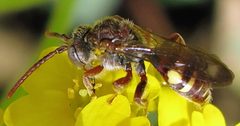
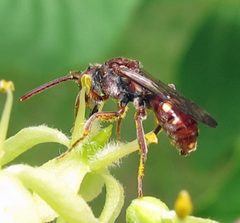
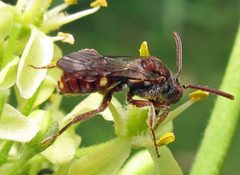
Nomada cressonii is a kleptoparasitic cuckoo bee in the Apidae, native to North America. As a member of the Nomada, it exhibits the characteristic of laying in the nests of species rather than constructing its own nest or collecting pollen. The species is named after entomologist Ezra Townsend Cresson. Like other nomad bees, females likely locate host nests using chemical cues and possess reduced body hair compared to pollen-collecting bees.
Pronunciation
How to pronounce Nomada cressonii: /nɔˈmaːda krɛˈsoni.aɪ/
These audio files are automatically generated. While they are not always 100% accurate, they are a good starting point.
Identification
Nomada cressonii can be distinguished from other Nomada by specific morphological features typical of the , including reduced body hair and often striking yellow, red, and black color patterns. Accurate identification to species level requires examination of detailed morphological characters such as facial markings, thoracic patterns, and genitalia structure. The species may be confused with other Nomada species in the same geographic region; precise determination typically requires taxonomic knowledge or reference to original species descriptions.
Images
Habitat
Distribution
North America, with confirmed records from Vermont, United States. The is part of the Nearctic fauna of nomad bees.
Host Associations
Ecological Role
As a kleptoparasite, Nomada cressonii functions as a natural regulator of its . By parasitizing host nests, it reduces host reproductive success and may influence host and foraging . The species contributes to bee diversity and represents an evolutionary specialization within the bee fauna.
Human Relevance
Nomada cressonii has limited direct human relevance but contributes to scientific understanding of and coevolutionary relationships. The may serve as an indicator of healthy bee and intact - relationships in natural .
Similar Taxa
- Nomada flavoguttataSimilar member with comparable kleptoparasitic lifestyle and coloration patterns; distinguished by specific markings and distribution
- EpeolusRelated cuckoo bee with similar parasitic and reduced hair; distinguished by different associations (typically Colletes bees) and morphological details
More Details
Nomenclature
The epithet 'cressonii' honors Ezra Townsend Cresson (1838-1896), a prominent American entomologist who made significant contributions to the study of Hymenoptera, particularly bees and . Robertson described this species in 1893.
Sources and further reading
- BugGuide
- GBIF taxonomy match
- iNaturalist taxon
- NCBI Taxonomy
- Catalogue of Life
- Image by UC Davis Alumnus Ian Wright Appears in ESA World Calendar | Bug Squad
- entomology | Blog - Part 10
- Northern Ireland, invertebrate finds in review 2023 - Buglife Blog - Buglife
- Not-so Solitary Bees - Buglife Blog - Buglife
- Bare ground experiments to help save rare bees and wasps - Buglife Blog - Buglife
- behaviour | Blog