
Nomada australis
Mitchell, 1962
Five-spined Nomad
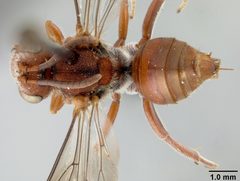
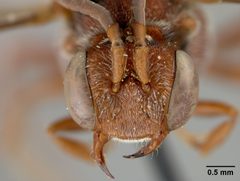
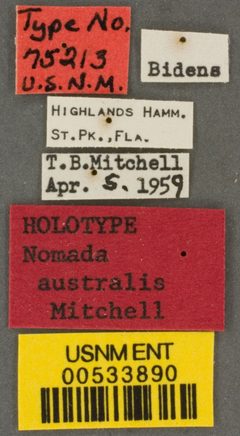
Nomada australis is a of cuckoo bee in the Apidae, described by Mitchell in 1962. As a member of the Nomada, it is a kleptoparasite that lays its in the nests of species. The species is found in North America, with confirmed records from Vermont, United States. Like other nomad bees, it lacks the branched body hairs typical of pollen-collecting bees and relies on other bees to provision its offspring.
Pronunciation
How to pronounce Nomada australis: /nɔˈmɑːdə ɒˈstreɪlɪs/
These audio files are automatically generated. While they are not always 100% accurate, they are a good starting point.
Identification
As a Nomada , N. australis can be distinguished from non-cuckoo bees by its relatively sparse, unbranched body hairs and -like appearance. Specific diagnostic features for N. australis include the five spines referenced in its , likely on the scutellum or other thoracic structures, though detailed morphological descriptions are not widely documented. Identification to species level within Nomada typically requires examination of genitalic characters and precise coloration patterns.
Images
Distribution
North America; specifically recorded from Vermont, United States. The name 'australis' (southern) may reflect the type locality or relative distribution within its range rather than a southern continental distribution.
Host Associations
- Andrena species - probable Based on -level association; Nomada typically parasitize nests of mining bees in the genus Andrena
Ecological Role
Kleptoparasite (cuckoo bee) that exploits nests of . As a nest , it contributes to of its host species and represents a component of native bee diversity.
Similar Taxa
- Other Nomada speciesSimilar kleptoparasitic lifestyle and -like appearance; requires detailed morphological examination to distinguish
- Epeolus speciesAnother of cuckoo bees with similar and appearance; Epeolus typically parasitize Colletes nests rather than Andrena
More Details
Taxonomic note
The specific epithet 'australis' is somewhat misleading given the North American distribution; this likely reflects the original description context or relative position within a group rather than a southern geographic range.
Sources and further reading
- BugGuide
- Wikipedia
- GBIF taxonomy match
- iNaturalist taxon
- NCBI Taxonomy
- Catalogue of Life
- Image by UC Davis Alumnus Ian Wright Appears in ESA World Calendar | Bug Squad
- entomology | Blog - Part 10
- Northern Ireland, invertebrate finds in review 2023 - Buglife Blog - Buglife
- Not-so Solitary Bees - Buglife Blog - Buglife
- Bare ground experiments to help save rare bees and wasps - Buglife Blog - Buglife
- behaviour | Blog