
Hexepeolus rhodogyne
Linsley & Michener, 1937
Hexepeolus rhodogyne is a of cuckoo bee in the tribe Hexepeolini, Nomadinae. It is one of few described species in the Hexepeolus, a group of rare and poorly known cleptoparasitic bees. The species was described by Linsley and Michener in 1937. Records indicate it occurs in North America, though specific details of its remain largely undocumented.
Pronunciation
How to pronounce Hexepeolus rhodogyne: //ˌhɛksɛˈpiːələs ˌroʊdəˈdʒaɪniː//
These audio files are automatically generated. While they are not always 100% accurate, they are a good starting point.
Identification
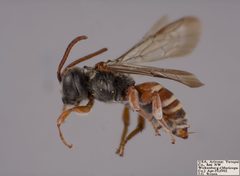
Hexepeolus are distinguished from other Nomadinae by reduced wing venation, particularly the absence or strong reduction of the second submarginal . Hexepeolus rhodogyne can be separated from the only other described species in the , H. lectus, by differences in coloration and pattern; H. rhodogyne has reddish or ferruginous coloration on the (hence the specific epithet 'rhodogyne,' meaning 'red female').
Images
Distribution
North America. Specific locality records are sparse.
Behavior
As a member of Nomadinae, this is presumed to be a (cuckoo bee) that lays in the nests of other bees. The specific species has not been documented.
Ecological Role
Likely functions as a of ground-nesting bees, though specific relationships and ecological impacts remain unknown.
Similar Taxa
- Hexepeolus lectusThe only other described in the ; differs in coloration (H. lectus is darker, lacking the reddish of H. rhodogyne) and has been recorded from different geographic areas.
- Other Nomadinae generaHexepeolus is distinguished by reduced wing venation (absent or second submarginal ) and specific features of the male genitalia and antennal structure.
More Details
Taxonomic rarity
Hexepeolus is among the most poorly known of bees, with only two described and very few specimens known in collections. The genus was historically placed in its own tribe, Hexepeolini, reflecting its distinctive .
Etymology
The specific epithet 'rhodogyne' derives from Greek 'rhodon' (rose/red) and '' (woman/female), referring to the reddish coloration of the female .