
Bombus ternarius
Say, 1837
Tricolored Bumble Bee, Orange-belted Bumblebee
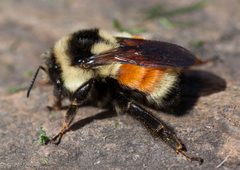
Bombus ternarius is a small, slender bumblebee distinguished by its striking tricolor pattern of yellow, orange, and black bands. It is a ground-nesting, eusocial with an colony cycle lasting one season. The species is common throughout the northeastern United States and much of Canada, where it serves as an important of native plants including Rubus, goldenrods, Vaccinium, and milkweeds.
Pronunciation
How to pronounce Bombus ternarius: /ˈbɒm.bəs tɜːrˈneɪ.ri.əs/
These audio files are automatically generated. While they are not always 100% accurate, they are a good starting point.
Identification
The tricolor pattern—yellow , orange band on abdominal segments 2–3, and black terminal segments—is diagnostic and distinguishes B. ternarius from most sympatric bumblebees. B. huntii in the western United States is nearly identical in coloration but has primarily yellow facial hairs rather than black. B. terricola is larger, has different coloration (black and yellow with no orange band), and is less efficient at flying between flowers. B. ternarius is more broadly distributed in Maine compared to B. terricola, which is restricted to higher elevations.
Images
Habitat
Ground-nesting that prefers small, shallow underground cavities such as rodent burrows or natural crevices. Found in temperate northern climates; most successful in northern regions but occasionally occurs farther south. Requires proximity to abundant, rewarding flowers for colony success.
Distribution
Northeastern United States and much of Canada. Range extends from Yukon to Newfoundland and Labrador and British Columbia. In the United States, occurs from New York and Pennsylvania west to Michigan, Washington, Wyoming, Utah, and Montana. Most abundant in northern temperate zones.
Seasonality
colony cycle. Queens emerge from hibernation in late April. fly from May to October. Entire colony dies in mid-autumn except for hibernating queens that overwinter under loose soil or leaf litter.
Diet
Nectar and pollen from Rubus (brambles), goldenrods (Solidago), Vaccinium (blueberries, cranberries), and milkweeds (Asclepias). Also documented foraging on Apocynum androsaemifolium. Nectar is stored in the crop; pollen is collected on body hairs and packed into corbiculae on hind legs.
Life Cycle
Complete with four stages: , larva, pupa, . lays fertilized eggs that become ; incubates by generating heat through abdominal contractions, consuming ~600 mg sugar daily. First workers emerge approximately one month after egg laying. Workers take over foraging and nest duties. In late summer, queen lays unfertilized eggs that develop into male drones, then reverts to fertilized eggs producing new queens. New queens mate, build fat reserves, and hibernate. Colony size rarely exceeds 200 individuals.
Behavior
Eusocial with reproductive division of labor: reproduces while perform foraging, nursing, and nest maintenance. Workers exhibit age-related task allocation—young workers perform in-nest duties, older workers transition to foraging. Foragers show individual learning, improving over first 10 trips and plateauing by 30 trips. Pollen foraging preferred in dry, low-humidity conditions. Sting lacks barbs, allowing repeated stinging without self-injury; not aggressive but stings in nest defense. Drones deposit trails on prominent objects to attract queens for mating.
Ecological Role
Important of native flowering plants and some agricultural crops. Performs buzz pollination on suitable flowers. Participates in resource partitioning with sympatric bumblebee —demonstrated more efficient inter-flower than B. terricola, enabling use of more widely spaced floral resources. Contributes to plant reproductive success through pollen transfer.
Human Relevance
Native valuable for services; historically one of few honey-producing bees in North America before introduction of Apis mellifera, though honey production is minimal. Subject of conservation concern due to broader bumblebee declines from loss, , climate change, and . Used in research on bumblebee , social , and climate change impacts.
Similar Taxa
- Bombus huntiiNearly identical tricolor pattern, but has primarily yellow facial hairs rather than black; restricted to western United States.
- Bombus terricolaSympatric in parts of range; larger with black and yellow coloration lacking orange band; less efficient at flying between flowers, restricted to higher elevations in Maine.
More Details
Etymology
Bombus is Latin for 'buzzing,' referring to the sound produced. Specific epithet ternarius refers to the number three, denoting the three-color pattern.
Caste determination
Larval appears determined by presence or absence of a -produced transmitted by direct contact during days 2–5 after ; presence forces development, absence permits queen development.
Sex ratio strategy
Colonies exhibit split strategies: approximately half of queens adopt early-switching (male-biased) and half late-switching (-biased) reproductive strategies, resulting in more even sex ratios than predicted by alone.
Sources and further reading
- BugGuide
- Wikipedia
- GBIF taxonomy match
- iNaturalist taxon
- NCBI Taxonomy
- Catalogue of Life
- Celebrating Bumble Bees on World Bee Day | Bug Squad
- Bumble Bee Mellowing Out on the Mallow | Bug Squad
- The Buzz: Protecting Our Bumble Bees | Bug Squad
- California Has No State Bee--Yet! | Bug Squad
- Saving California's Bumble Bees: Become a Citizen Scientist | Bug Squad
- Bumble Bees: Feeling Impact of Climate Change | Bug Squad
- Intraspecific Resource Partitioning in the Bunble Bees Bombus Ternarius and B. Pennsylvanicus
- FLORAL USE BY TWO SYMPATRIC BUMBLE BEE SPECIES (BOMBUS TERRICOLA AND BOMBUS TERNARIUS): EFFICIENCY CONSIDERATIONS
- Maine’s Bumble Bees (Hymenoptera: Apidae)—Part 2: Comparisons of a Common (Bombus ternarius) and a Rare (Bombus terricola) Species