
Bombus huntii
Greene, 1860
Hunt's Bumble Bee, Hunt Bumblebee
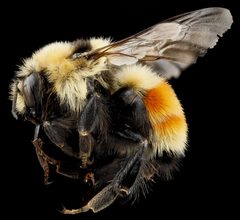
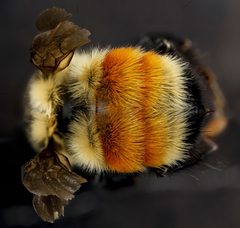
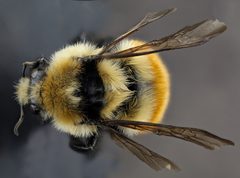
Bombus huntii is a native western North American with a broad range spanning western Canada to the Trans-Mexican Volcanic Belt. The occupies diverse from desert scrub to high-elevation pine and has been documented foraging on at least eight plant . While have declined, it remains among the more common bumble bees in western North America. Its was sequenced as part of the Beenome100 project.
Pronunciation
How to pronounce Bombus huntii: /ˈbɒm.bəs ˈhʌn.ti.aɪ/
These audio files are automatically generated. While they are not always 100% accurate, they are a good starting point.
Images
Habitat
Desert scrub, prairies, and meadows in the northern portion of its range. In Mexico, occurs in pine at high elevations, including the summits of tall volcanoes.
Distribution
Western North America from western Canada and the United States (east to Manitoba and Minnesota) south through Mexico to the Trans-Mexican Volcanic Belt.
Seasonality
Active in summer and fall in northern portions of range; flies throughout much of the year in Mexico.
Diet
Forages on rabbitbrush, thistles, sunflowers, penstemons, phacelias, currants, rudbeckias, and clovers.
Life Cycle
colony cycle with underground nesting. Colonies contain a , , males, and new queens. Only mated queens overwinter; colonies do not persist beyond one year.
Behavior
Nests underground. exhibit division of labor in nest .
Ecological Role
of wild flowering plants; experiments indicate efficient pollination of crop plants including tomatoes via buzz pollination.
Human Relevance
Susceptible to viruses including Black Virus and Deformed Wing Virus. Considered a viable candidate for commercial rearing as an alternative to non-native bees for crop pollination. Subject to declines attributed to loss, , climate change, and spillover from managed bees.
More Details
Conservation Status
Has experienced declines but remains one of the more common bumble bees in western North America.
Genomic Research
Whole sequenced as part of the Beenome100 project.
Sources and further reading
- BugGuide
- Wikipedia
- GBIF taxonomy match
- iNaturalist taxon
- NCBI Taxonomy
- Catalogue of Life
- Celebrating Bumble Bees on World Bee Day | Bug Squad
- Bumble Bee Mellowing Out on the Mallow | Bug Squad
- The Buzz: Protecting Our Bumble Bees | Bug Squad
- California Has No State Bee--Yet! | Bug Squad
- Saving California's Bumble Bees: Become a Citizen Scientist | Bug Squad
- Robbin Thorp Would Have Been Proud | Bug Squad