
Bombus fraternus
(Smith, 1854)
Southern Plains bumblebee
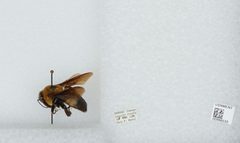
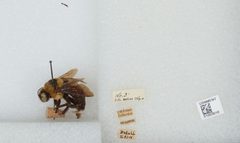
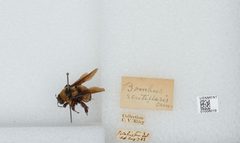
Bombus fraternus, commonly called the Southern Plains bumblebee, is a large bumblebee native to the United States east of the Rocky Mountains. It is classified in the subgenus Cullumanobombus and is currently listed as endangered, with estimated abundance below 15% of historical numbers. The species is distinguished by its mostly black coloration with yellow thoracic and abdominal bands and unusually flattened abdominal hairs.
Pronunciation
How to pronounce Bombus fraternus: //ˈbɒmbəs frəˈtɜːrnəs//
These audio files are automatically generated. While they are not always 100% accurate, they are a good starting point.
Identification
Distinguished from other bumblebees by flattened (not fluffy) abdominal hairs and the entirely black third tergal segment. The combination of large size, black-dominated coloration with yellow thoracic bands, and the unique flattened hair texture on the separates this from sympatric Bombus. Males distinguished by disproportionately large and elongated antennal segments.
Images
Appearance
Mostly black with yellow bands across and . Abdominal hairs appear flattened rather than fluffy, a distinctive trait among bumblebees. Queens measure 25–27 mm, 15–19 mm, and males 22–25 mm. Females have short yellow and black body hairs with flattened black hairs on the third tergal segment; and thorax sides usually black. Metasoma nearly rectangular and slightly flattened, with yellow hairs on first and second tergal segments and entirely black third tergal segment. Males have larger , long with segments nearly three times the scape length, and sometimes extensively yellow area between wings.
Habitat
Open prairies, meadows, and grasslands of the southeastern coastal plain and Great Plains. Occupies intact prairie, agricultural land, and urbanized areas with suitable floral and nesting resources. Nests underground in pre-existing holes or depressions, typically created by rodents or other animals; does not excavate its own nests.
Distribution
United States east of the Rocky Mountains, primarily in the southern Great Plains and Gulf Coastal Plain. Recorded in 27 states from North Dakota and New Jersey south to Florida, with scattered records in Chihuahua, Mexico. No records from Canada. Historically present across southern and central Great Plains and southeastern coastal plain; now rarely observed in northernmost parts of range.
Diet
Foraging with documented floral associations from at least 20 plant . Recorded visiting Asclepias, Bidens, Gaillardia (blanket flower), Lespedeza (bush clover), Cassia, Eryngium, Hypericum, Liatris, Melilotus, Monarda, Prunus padus, Ratibida, Solidago, and Vaccinium.
Life Cycle
Colonial lifecycle with colonies founded by solitary queens. Queens emerge, forage, and establish underground nests in pre-existing cavities. develop and assume foraging duties. Males produced later in season; mating occurs with new queens. Mated queens hibernate through winter in undisturbed sites with loose soil or leaf litter, typically close to ground surface. Specific site requirements not documented.
Behavior
Nests underground in abandoned rodent burrows or similar pre-formed cavities rather than excavating new tunnels. Forages across diverse open including agricultural and urban landscapes when floral resources available.
Ecological Role
of wild flowering plants and agricultural crops. foraging supports plant across diverse plant in prairie and grassland .
Human Relevance
with estimated at less than 15% of historical abundance. Subject to conservation concern due to documented decline. Occurs in agricultural landscapes and urban farms, suggesting potential in human-modified if floral and nesting resources maintained.
Similar Taxa
- Other Bombus speciesB. fraternus distinguished by flattened (not fluffy) abdominal hairs, a unique trait among bumblebees
- Bombus pensylvanicusOverlaps in range and ; B. fraternus has more extensive black on and distinctive flattened hair texture
More Details
Conservation Status
Listed as endangered; decline attributed to loss, exposure, and potentially spillover from commercial bees. Historical abundance estimated at less than 15% of former levels.
Taxonomic History
First described by Frederick Smith in 1854; originally placed in Apathus as Apathus fraternus. Now classified in subgenus Cullumanobombus within Bombus.
Sources and further reading
- BugGuide
- Wikipedia
- GBIF taxonomy match
- NCBI Taxonomy
- Catalogue of Life
- Celebrating Bumble Bees on World Bee Day | Bug Squad
- Bumble Bee Mellowing Out on the Mallow | Bug Squad
- The Buzz: Protecting Our Bumble Bees | Bug Squad
- California Has No State Bee--Yet! | Bug Squad
- Saving California's Bumble Bees: Become a Citizen Scientist | Bug Squad
- Bumble Bees: Feeling Impact of Climate Change | Bug Squad