
Bombus crotchii
Cresson, 1879
Crotch's bumble bee, Golden State bumble bee, Crotch's bumblebee
Bombus crotchii, commonly called Crotch's or the Golden State bumble bee, is a short- to medium-tongue bumble bee to California and adjacent regions. The is classified as endangered under the California Act and listed as imperiled globally by the IUCN. It has experienced severe declines attributed to loss, exposure, climate change, and inbreeding depression. The species is a dietary and important of native plants and agricultural crops.
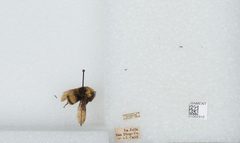
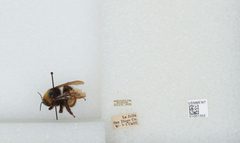
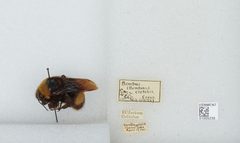
Identification
Bombus crotchii is most readily confused with Bombus californicus and Bombus occidentalis, which share similar color patterns. It can be distinguished by the combination of black T1, yellow T2 (sometimes with medial black), and black or orange T3-5. The short to medium tongue length separates it from long-tongued . Males are identifiable by their exceptionally large and yellow facial hair. Queens and are distinguished by size (queens 23-24 mm, workers 14-18 mm).
Images
Appearance
Queens and possess a black and with yellow on the thorax and sometimes yellow on the scutellum. The first abdominal (T1) is entirely black or black medially. T2 is usually yellow, sometimes black medially. Terga 3-5 are black or orange, and T6 is black. Queens measure 23-24 mm in length; workers are smaller at 14-18 mm. Males differ markedly: they have very large occupying much of the , yellow facial hair, a broad black stripe on the mid-thorax, yellow on the anterior , and predominantly black and reddish-yellow on the abdomen.
Habitat
Inhabits grassland and scrub in coastal and inland California. Requires hotter and drier conditions than most and tolerates a narrow climatic range. Nests underground, typically in abandoned rodent burrows. Non-migratory. unknown but presumed similar to , involving hibernation in leaf litter or soft soil.
Distribution
to California, United States, with extant but uncommon in Baja California, Mexico, and Nevada. Historical range included the Central Valley, but the has retracted from northern portions. Current range estimated at 144,003 km². Most observations occur in southern California coastal areas.
Seasonality
Queens active March to May, peaking in April. active April to August, peaking May to June. Males present May to September, peaking in July.
Diet
Dietary . Documented food plants include milkweeds (Asclepias), dustymaidens (Chaenactis), lupines (Lupinus), medics (Medicago), phacelias (Phacelia), sages (Salvia), snapdragons (Antirrhinum), Clarkia, poppies (Papaver), and wild buckwheats (Eriogonum). Milkweed is a preferred nectar source.
Life Cycle
Eusocial cycle. Queens emerge in March, establish colonies in underground nests (often abandoned rodent dens), and produce offspring. Workers forage from April through August. Males produced later in season, active May through September. Colony cycle concludes by late summer or early fall. New queens mate and enter for winter.
Behavior
Exhibits buzz pollination, vibrating wing muscles to dislodge pollen from flowers. Non-migratory; colonies established anew each year by founding queens. Foraging activity concentrated in warmer, drier microhabitats compared to sympatric .
Ecological Role
Important native of wild flowering plants and agricultural crops. Performs buzz pollination, benefiting plants with poricidal anthers including tomatoes, peppers, and cranberries. Serves as pollinator for milkweeds, supporting monarch butterfly quality through enhanced plant .
Human Relevance
Candidate under the California Endangered Species Act (listed June 2019). Subject of conservation petitions by Xerces Society, Defenders of Wildlife, and Center for Food Safety. Monitored by California Bumble Bee Atlas science project. Decline attributed to neonicotinoid , urbanization, agricultural intensification, and climate change. Relative abundance declined 98% over one decade per Xerces Society estimates.
Similar Taxa
- Bombus californicusShares similar color pattern; distinguished by differences in abdominal coloration and distribution patterns
- Bombus occidentalisOverlapping coloration; B. occidentalis has different tergal pattern and broader climatic
More Details
Conservation status
IUCN Red List: Imperiled (2019 evaluation). California Act: Candidate Endangered (June 2019). Current relative abundance estimated at 2.32% of historic levels; persistence in current range at 20.48% of historic occupancy.
Threats
Primary threats include neonicotinoid (with persisting several months), climate change and increasing aridity, urbanization, agricultural intensification, and inbreeding depression from small sizes.
Research significance
Subject of ongoing conservation research and science monitoring. One of four petitioned for California protection in 2018, with legal precedent established confirming eligibility under CESA.
Sources and further reading
- BugGuide
- Wikipedia
- GBIF taxonomy match
- iNaturalist taxon
- NCBI Taxonomy
- Catalogue of Life
- The Buzz: Protecting Our Bumble Bees | Bug Squad
- Saving California's Bumble Bees: Become a Citizen Scientist | Bug Squad
- Remembering the Legendary Robbin Thorp | Bug Squad
- Celebrating Bumble Bees on World Bee Day | Bug Squad
- Bumble Bee Mellowing Out on the Mallow | Bug Squad
- California Has No State Bee--Yet! | Bug Squad