
Anthophora hololeuca
Cockerell, 1923
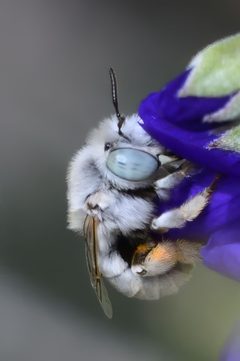
Anthophora hololeuca is a solitary digger bee in the Apidae, first described by Cockerell in 1923. Like other members of the Anthophora, it is a ground-nesting that excavates burrows in soil or sand substrates. The occurs in North America and Middle America, though specific details of its remain poorly documented compared to better-studied such as Anthophora bomboides.
Pronunciation
How to pronounce Anthophora hololeuca: //ænˈθɒfərə ˌhɒloʊˈljuːkə//
These audio files are automatically generated. While they are not always 100% accurate, they are a good starting point.
Images
Distribution
North America and Middle America. GBIF records indicate presence in both regions, though specific locality data within these broad areas are not detailed in available sources.
Ecological Role
As a solitary , likely functions as a in its native range, though specific plant associations have not been documented in available literature.
Similar Taxa
- Anthophora bomboides with overlapping geographic range in western North America; both are ground-nesting digger bees. A. bomboides has been extensively studied at Bodega , California, where it constructs distinctive turreted nests in sand cliffs and mimics bumble bees (Bombus vosnesenskii). No evidence indicates A. hololeuca shares these specific traits.
Sources and further reading
- BugGuide
- GBIF taxonomy match
- iNaturalist taxon
- NCBI Taxonomy
- Catalogue of Life
- Digging the Digger Bees and the Newly Published Research | Bug Squad
- UC Davis: All A'Buzz With Bee Nests and Art | Bug Squad
- Congratulations, Microbiologist Shawn Christensen: Best Dissertation | Bug Squad
- A Silver Digger Bee in Flight at Bodega Head | Bug Squad
- The Beckoning Bees at Bodega Bay | Bug Squad
- California Has No State Bee--Yet! | Bug Squad