
Perdita rhois
Cockerell, 1901
Rhus Fairy Bee
Perdita rhois is a of mining bee in the Andrenidae, described by Cockerell in 1901. It is commonly known as the Rhus Fairy , a name referencing its association with Rhus (sumac) plants. The species occurs in Central America and North America, where it functions as a . As a member of the Perdita, it belongs to one of the most diverse bee genera in North America, characterized by small size and often specialized -plant relationships.
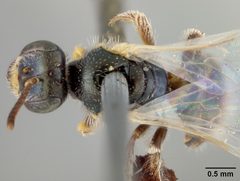
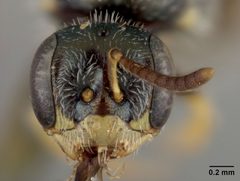
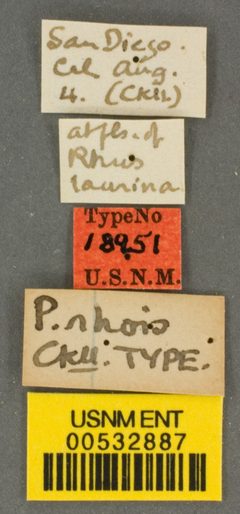
Pronunciation
How to pronounce Perdita rhois: /pɛrˈdiːtə roɪs/
These audio files are automatically generated. While they are not always 100% accurate, they are a good starting point.
Identification
Perdita rhois can be distinguished from other Perdita by its specific association with Rhus (sumac) plants. Members of the Perdita are generally small mining bees, typically 2–10 mm in length, with slender bodies and relatively simple body sculpturing compared to other Andrenidae. Species-level identification within Perdita requires examination of microscopic characters including genitalia, facial markings, and punctation patterns. The specific epithet 'rhois' directly references its sumac host association, which may aid in field recognition when found foraging on Rhus species.
Images
Habitat
include areas where plants of the Rhus (sumac) occur, including open woodlands, forest edges, prairies, and disturbed sites. As a ground-nesting mining bee, it requires well-drained soils suitable for burrow excavation.
Distribution
Recorded from Central America and North America. GBIF distribution records indicate presence in Middle America and North America.
Diet
feed on nectar and pollen. Based on the and specific epithet, pollen collection appears specialized on or strongly associated with Rhus (sumac) , though the degree of oligolecy requires confirmation.
Host Associations
- Rhus - pollen/nectar sourceInferred from epithet 'rhois' and 'Rhus Fairy '
Life Cycle
As a member of Andrenidae, it has a solitary lifestyle with females constructing individual burrows in soil. Females provision nest with pollen and nectar for larval development. Development likely includes , larval, pupal, and stages with potential for in response to environmental conditions, as documented in related Perdita .
Behavior
Solitary ground-nesting typical of Andrenidae. Females excavate burrows in soil and provision with pollen and nectar. Males likely patrol plants or nesting to locate females.
Ecological Role
of Rhus (sumac) and potentially other flowering plants in its range. Contributes to native diversity and function in North and Central American .
Human Relevance
Contributes to pollination services in natural and potentially agricultural landscapes. As a native , it may serve as an indicator of quality and native plant health. No documented direct economic use.
Similar Taxa
- Other Perdita speciesMany Perdita are morphologically similar and require microscopic examination for identification; plant association with Rhus helps distinguish P. rhois
- Other AndrenidaeMining bees in related share ground-nesting but differ in body size, sculpturing, and often in plant preferences
More Details
Etymology
The specific epithet 'rhois' derives from the Greek name for sumac (Rhus), directly referencing the 's plant association. This follows a common pattern in Perdita where epithets often indicate host plant relationships.
Sources and further reading
- BugGuide
- Wikipedia
- GBIF taxonomy match
- iNaturalist taxon
- Catalogue of Life
- Primary Type List | Entomology Research Museum
- You, Too, Can Plant a Pollinator Garden | Bug Squad
- 'Am I Even a Bee?' Identity Crisis Unfolds in This Charming Book | Bug Squad
- Researchers Develop Genome Map for Mojave Poppy Bee
- Bug Eric: World Bee Day....A Little "Bee"hind
- The best species name ever! | Beetles In The Bush