
Perdita minima
Cockerell, 1923
Euphorb Mini-Fairy Bee
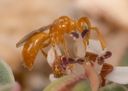
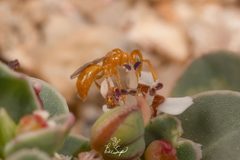
Perdita minima is the smallest known , measuring under 2 mm in length and weighing approximately 0.33 mg. This solitary mining bee belongs to the Andrenidae and is native to the southwestern United States, where it inhabits desert environments. It constructs small nests in sandy soils and has been observed feeding on and pollinating spurges (Euphorbia species).
Pronunciation
How to pronounce Perdita minima: //pɛrˈdiː.tə ˈmɪ.nɪ.mə//
These audio files are automatically generated. While they are not always 100% accurate, they are a good starting point.
Identification
Distinguished from all other bees by its extremely small size (under 2 mm). Smaller than other Perdita and all other known bees. May be confused with other minute Hymenoptera such as Mymaridae (fairyflies), but can be identified as a by morphological features of the Andrenidae.
Images
Habitat
Desert areas with sandy soils suitable for nest excavation.
Distribution
Southwestern United States (North America). Records indicate presence in Middle America and North America.
Diet
Feeds on and pollinates spurges (Euphorbia ).
Life Cycle
Solitary. Nests in small burrows excavated in sandy soils.
Behavior
Solitary nesting . Constructs nests in sandy soils.
Ecological Role
of Euphorbia in desert .
Human Relevance
Contributes to native diversity awareness; cited as example of extreme miniaturization in bees and the diversity of native often overlooked in favor of honey bees.
Similar Taxa
- Other Perdita speciesLarger size; P. minima is notably smaller than
- Mymaridae (fairyflies)Similar extremely small size, but different with distinct wing venation and body structure
More Details
Sources and further reading
- BugGuide
- Wikipedia
- GBIF taxonomy match
- iNaturalist taxon
- Catalogue of Life
- You, Too, Can Plant a Pollinator Garden | Bug Squad
- 'Am I Even a Bee?' Identity Crisis Unfolds in This Charming Book | Bug Squad
- Primary Type List | Entomology Research Museum
- Researchers Develop Genome Map for Mojave Poppy Bee
- Bug Eric: World Bee Day....A Little "Bee"hind
- The best species name ever! | Beetles In The Bush