
Macrotera
Smith, 1853
Goblin Bees
Species Guides
3- Macrotera echinocacti(barrel cactus macrotera)
- Macrotera latior
- Macrotera texana(Texas macrotera)
Macrotera is a of mining bees (Andrenidae) native to North America, with approximately 30 . These bees range from 2.0 to 16.0 mm in body length and are predominantly found in desert regions of the United States and Mexico. The genus was segregated from Perdita by C.D. Michener in 2000. Most species exhibit extreme pollen specialization (oligolecty), with documented associations to Sphaeralcea and Cactaceae.
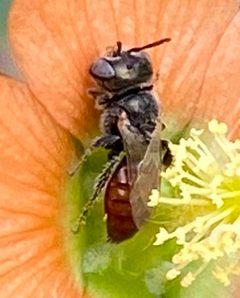
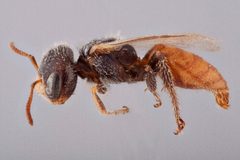
Pronunciation
How to pronounce Macrotera: /ˌmækroʊˈtɛrə/
These audio files are automatically generated. While they are not always 100% accurate, they are a good starting point.
Identification
Images
Habitat
Desert regions of the United States and Mexico. At least one (M. opuntiae) is documented as stone-nesting, utilizing rocky substrates for nest construction.
Distribution
Native to North America. Center of diversity in desert regions of the southwestern United States and Mexico. Documented range includes Colorado, Montana (first records representing range expansion), Nebraska (new state record), and western Colorado.
Diet
Most are extreme pollen (oligoleges). Documented pollen sources include the plant Sphaeralcea and various Cactaceae. M. opuntiae is oligolectic on cacti.
Host Associations
- Sphaeralcea - pollen sourcedocumented for multiple
- Cactaceae - pollen sourcedocumented for multiple including M. opuntiae
Behavior
At least one (M. opuntiae) exhibits stone-nesting , which is rare among bees. This species is among the few documented stone-nesting species.
Similar Taxa
More Details
Taxonomic History
Most were described by P.H. Timberlake and T.D.A. Cockerell. The was revised and elevated from synonymy under Perdita by C.D. Michener in 2000.
Nesting Biology
Stone-nesting in M. opuntiae represents an unusual nesting substrate choice among bees, which more commonly nest in soil or pre-existing cavities.
Sources and further reading
- BugGuide
- Wikipedia
- GBIF taxonomy match
- iNaturalist taxon
- NCBI Taxonomy
- Catalogue of Life
- Comparative study of pectic polysaccharides from Premna microphylla and Abelia macrotera leaves: Physicochemical properties and gelation behavior
- First records, phenology, habitat, and host-plant associations of <i>Macrotera opuntiae</i> (Cockerell) (Hymenoptera: Andrenidae) in Montana