
Andrena astragali
Viereck & Cockerell, 1914
Death Camas Mining Bee, Death Camas Bee, Death Camas Andrena
Andrena astragali is a solitary mining bee in the Andrenidae, native to North America. It is remarkable for its specialized association with highly toxic plants in the Toxicoscordion (death camas), whose alkaloid zygacine is lethal to most other bees. The was first described in 1914 from a specimen collected on Astragalus in Nebraska, though its primary plants were later discovered to be Toxicoscordion species. It is considered the only species known to tolerate death camas toxins, making it a unique example of -plant involving chemical defense.
Pronunciation
How to pronounce Andrena astragali: /ænˈdriː.nə əˈstræ.ɡə.laɪ/
These audio files are automatically generated. While they are not always 100% accurate, they are a good starting point.
Identification
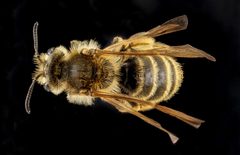
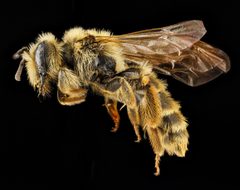
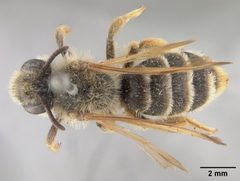
Distinguished from other western North American Andrena by combination of larger body size and presence of two toothlike projections on the . Most similar to the European Andrena fulvida. The reddish-tinted, glassy wings without dark marginal banding also aid identification.
Images
Appearance
Females measure 10–13 mm in length, males 8–12 mm. Body is black with reddish to creamy white hairs. The facial quadrangle is broader than long. Wings are glassy with a reddish tint, lacking a dark margin but dusky at the apex. Distinguished from other western North American Andrena by larger size and two toothlike projections on the .
Habitat
Associated with open supporting Toxicoscordion (meadow deathcamas and relatives). As a ground-nesting mining bee, requires bare or sparsely vegetated soil for nest excavation. Specific soil preferences not documented.
Distribution
North America. Precise range boundaries not well documented in available sources.
Seasonality
Active in spring, coinciding with flowering period of Toxicoscordion . Specific period dates not documented.
Diet
Oligolectic on Toxicoscordion , primarily Toxicoscordion venenosum, T. nuttallii, and T. paniculatum. Females may visit other flowers for nectar but gather pollen predominantly from death camas. Larvae are provisioned with pollen-nectar mixtures containing at least 30 μg of zygacine alkaloid.
Host Associations
- Toxicoscordion venenosum - primary pollen meadow deathcamas
- Toxicoscordion nuttallii - pollen
- Toxicoscordion paniculatum - pollen
- Toxicoscordion fremontii - pollen formerly Zigadenus fremontii
Life Cycle
Solitary ground-nesting . Females excavate tunnels in soil, provision individual with pollen and nectar mixture containing zygacine, lay , and seal cells with soil plugs. Detailed developmental stages and not documented.
Behavior
Females forage predominantly at Toxicoscordion flowers, carrying pollen loads with up to 80% pollen. Males emerge and patrol nesting areas seeking females. Nesting occurs in in suitable soil substrates. The 's of zygacine toxin is hypothesized to be an to deter and/or , though this remains unconfirmed.
Ecological Role
Primary of Toxicoscordion ; flowers that self-pollinate fail to form seed capsules at more than triple the rate of -pollinated or artificially cross-pollinated flowers. This represents a highly specialized mutualism where the bee gains exclusive access to pollen resources while the plant achieves effective pollination. The bee's toxin may also provide chemical defense against natural enemies.
Human Relevance
Of scientific interest as a model for studying -plant and biochemical to plant secondary compounds. No documented economic importance or direct human interactions. The epithet astragali reflects a taxonomic misattribution based on the first collection site rather than actual use.
Similar Taxa
- Andrena fulvidaMost visually similar ; European in distribution
Misconceptions
The name astragali derives from the Astragalus (locoweeds), based on the first specimen being collected on that plant in Nebraska. However, this was an outlier observation; the species is actually a on Toxicoscordion (death camas), not Astragalus. The name Andrena zygadeni was a later synonym based on specimens from California feeding on what was then called Zigadenus fremontii (now Toxicoscordion fremontii).
More Details
Toxin tolerance mechanism
The physiological mechanism enabling A. astragali to tolerate zygacine, a steroidal alkaloid lethal to other bees including Osmia lignaria and honeybees, has not been elucidated. This is considered unique among bees and represents a significant evolutionary .
Conservation implications
The highly specialized diet makes this vulnerable to loss or decline of Toxicoscordion . The plant is itself toxic to livestock, potentially leading to habitat management conflicts.
Sources and further reading
- BugGuide
- Wikipedia
- GBIF taxonomy match
- iNaturalist taxon
- NCBI Taxonomy
- Catalogue of Life
- Primary Type List | Entomology Research Museum
- Not-so Solitary Bees - Buglife Blog - Buglife
- Northern Ireland, invertebrate finds in review 2023 - Buglife Blog - Buglife
- In a New Study, Spring Forest Bees Get Their Due
- Bare ground experiments to help save rare bees and wasps - Buglife Blog - Buglife
- What’s in a name….? - Buglife Blog - Buglife