
Lauritrioza
Conci & Tamanini, 1986
bay sucker
Species Guides
1- Lauritrioza alacris(Bay Sucker)
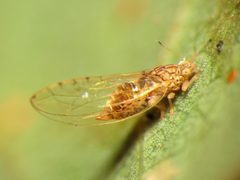
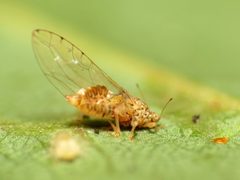
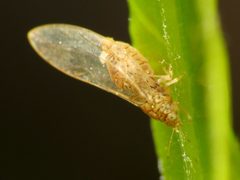
Lauritrioza is a of psyllids (Hemiptera: Triozidae) containing the single L. alacris. The genus is defined by its obligate association with Laurus species, on which it induces distinctive leaf-edge galls. and nymphs inhabit these galls, with nymphs producing white waxy secretions. The genus has expanded from its native European range through human-mediated introduction to western North America, Brazil, and Jordan.
Pronunciation
How to pronounce Lauritrioza: //ˌlaʊ.rɪˈtraɪ.oʊ.zə//
These audio files are automatically generated. While they are not always 100% accurate, they are a good starting point.
Identification
Lauritrioza is distinguished from other Triozidae by its status and exclusive association with Laurus . The galls it produces—thickened, downward-rolled leaf margins forming pale elongated pouches—are diagnostic. resemble other psyllids in general body plan but are identified to by host association and gall .
Images
Habitat
Young leaves of Laurus , particularly in cultivated settings such as commercial plantations and home gardens. overwinter in leaf litter or within galls.
Distribution
Native to Europe, including the British Isles. Introduced to western North America, Brazil (first detected Pelotas 1949; Rio de Janeiro 1953; Dois Lajeados, Rio Grande do Sul), and Jordan (first recorded in Amman).
Diet
Phloem sap of Laurus .
Host Associations
- Laurus nobilis - primary bay laurel; commercial plantations and home gardens
- Laurus azorica - Azores laurel
- Laurus novocanariensis -
- Persea indica -
Life Cycle
All developmental stages (, immatures, ) occur on young leaves. Galls can house two per summer, with up to thirty nymphs per gall. Adults overwinter in leaf litter or within galls.
Behavior
Nymphs induce gall formation by causing leaf margins to thicken and roll downward, creating elongated tube-shaped shelters. Nymphs secrete white wax. and immatures cohabit galls.
Ecological Role
Herbivore and gall-former on Laurus . In introduced ranges, functions as a pest of commercial bay laurel plantations, causing damage through gall formation that may reduce leaf quality and yield.
Human Relevance
Economic pest of bay laurel (Laurus nobilis) in commercial , particularly in introduced ranges (Brazil, Jordan). Gall formation renders leaves unmarketable for culinary use.
Similar Taxa
Sources and further reading
- BugGuide
- Wikipedia
- iNaturalist taxon
- NCBI Taxonomy
- Catalogue of Life
- First record of the bay sucker, Lauritrioza alacris (Flor) (Hemiptera: Triozidae), in Jordan
- Outbreak of Lauritrioza alacris (Flor, 1861) (Hemiptera, Triozidae) in a commercial plantation of bay laurel (Laurus nobilis L., Lauraceae) in Brazil