
Acizzia acaciaebaileyanae
(Froggatt, 1901)
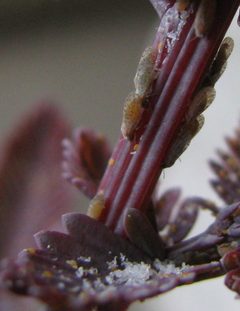
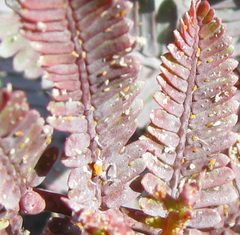
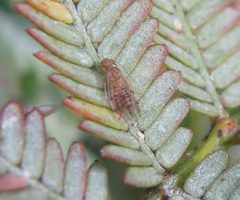
Acizzia acaciaebaileyanae is a specialized on Acacia baileyana, a widely planted ornamental acacia. Native to Australia, it has spread globally through human transport of its plant. Despite forming dense , it has been observed not to cause visible damage to the host. The species exemplifies inadvertent introduction of herbivores via horticultural trade.
Pronunciation
How to pronounce Acizzia acaciaebaileyanae: /əˈsɪziə əˌkeɪʃiəˌbeɪliəˈneɪi/
These audio files are automatically generated. While they are not always 100% accurate, they are a good starting point.
Identification
This is distinguished from other Acizzia by its association with Acacia baileyana; and nymphs are found on this . Specific morphological characters separating it from require examination. The nymphs produce waxy secretions typical of psyllids. Confirmation likely requires reference to original description or taxonomic keys for Australian Psyllidae.
Images
Habitat
Occurs on Acacia baileyana in cultivated settings including gardens, parks, and urban plantings. Has been observed on Acacia podalyriifolia as an additional . Not known from natural Acacia outside Australia.
Distribution
Native to Australia. Introduced to New Zealand, South Africa, Italy, and California (USA). Distribution tracks the global horticultural spread of Acacia baileyana.
Diet
Phloem-feeding on Acacia baileyana; also recorded from Acacia podalyriifolia.
Host Associations
- Acacia baileyana - primary Cootamundra wattle, widely planted ornamental
- Acacia podalyriifolia - secondary occasional association
Life Cycle
Behavior
Forms dense on foliage. Nymphs are and feed in groups. are active jumpers when disturbed.
Ecological Role
herbivore; do not appear to affect plant vigor based on available observations. Role in native Australian is unstudied.
Human Relevance
Accidentally introduced to multiple countries via horticultural trade of Acacia baileyana. Not reported as a pest; appears benign despite high potential. Serves as an indicator of plant provenance and introduction .
Similar Taxa
- Other Acizzia species share general and Acacia associations; plant specificity is the primary distinguishing feature for field identification.
More Details
Nomenclature
Originally described as Psylla acaciaebaileyanae by Froggatt in 1901, later transferred to Acizzia.
Invasion biology note
The demonstrates how herbivores can establish globally through plant introductions without undergoing host shifts, and that such introductions need not result in pest status.