
Craspedolepta subpunctata
(Foerster, 1848)
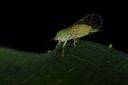
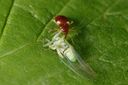
Craspedolepta subpunctata is a in the Aphalaridae, primarily associated with fireweed (Chamaenerion angustifolium, formerly Epilobium angustifolium). In Scotland, it was identified as a of 'Candidatus Liberibacter solanacearum' (Lso), harboring two novel haplotypes (Cras1 and Cras2)—the first report of Lso in the Aphalaridae family. The species has a more restricted altitudinal range than its C. nebulosa, limited by thermal constraints on development. It occurs in northern Europe and has been recorded across Canada.
Pronunciation
How to pronounce Craspedolepta subpunctata: /kræˌspiːdoʊˈlɛptə səbˌpʌŋkˈteɪtə/
These audio files are automatically generated. While they are not always 100% accurate, they are a good starting point.
Identification
Distinguished from Craspedolepta nebulosa by altitudinal distribution: C. subpunctata occupies lower elevations and does not extend as high on shared plants. Interspecific competitive effects between the two appear negligible. Specific morphological diagnostic features not provided in available sources.
Images
Habitat
Field margins of carrot and parsnip growing areas in Scotland; associated with fireweed (Chamaenerion angustifolium) in upland areas of southern Norway. Distribution limited by available heat budgets affecting development rates.
Distribution
Scotland: Milnathort (Perth and Kinross), Howe of Fife (Fife), and SASA Farm (Midlothian). Not recorded at Elgin, Forfar, Tyninghame, Scone, West Perth, or Tayport sites. Norway: Hardangervidda area. Canada: Alberta, British Columbia, Labrador, Manitoba, New Brunswick, Newfoundland, Nova Scotia, Nunavut, Northwest Territories, Ontario, Prince Edward Island, Quebec, Saskatchewan, Yukon.
Diet
Phloem-feeding on fireweed (Chamaenerion angustifolium). Incidental presence on carrot plants documented but not established as a primary .
Host Associations
- Chamaenerion angustifolium - primary Rosebay willowherb; main feeding and breeding . Formerly classified as Epilobium angustifolium.
- Daucus carota - incidentalCarrot; specimens found in carrot growing areas but not confirmed as reproductive
- Pastinaca sativa - incidentalParsnip; found in parsnip growing areas
Behavior
Most abundant in field margins at the Milnathort site in Scotland. Unable to establish viable above current upper altitudinal range limits even when plant is present, as demonstrated by transplant experiments.
Ecological Role
of novel 'Candidatus Liberibacter solanacearum' haplotypes Cras1 and Cras2. Potential role in Lso and spillover to Apiaceous crops, though transmission capability to crops has not been experimentally demonstrated.
Human Relevance
Epidemiological significance as a novel for 'Candidatus Liberibacter solanacearum', a affecting Solanaceous and Apiaceous crops. Raises concern for carrot and potato industries regarding potential spread of new Lso haplotypes. Not known as a direct agricultural pest.
Similar Taxa
- Craspedolepta nebulosaShares plant Chamaenerion angustifolium and overlapping geographic range; distinguished by higher altitudinal distribution and more efficient development at lower heat availability
- Trioza anthrisciBoth harbor 'Candidatus Liberibacter solanacearum' in Scotland; T. anthrisci carries haplotype C while C. subpunctata carries novel haplotypes Cras1 and Cras2
- Trioza urticaeBoth documented as Lso in Scottish carrot-growing regions; T. urticae associated with Urtica dioica and carries haplotype U
More Details
Lso haplotype variation
Two novel Lso haplotypes characterized from this : Cras1 (with subvariants Cras1a and Cras1b differing by 3 SNPs in the 50S rplJ/rplL gene region) and Cras2. rates varied geographically: 55.81% at Milnathort (Cras1a ), 100% at Howe of Fife (Cras1a only), and 75% at SASA Farm (Cras1b only). These haplotypes are phylogenetically most closely related to Lso haplotype H found in carrot and parsnip.
Thermal limitation
Upper altitudinal range limit determined by heat budget constraints on development rather than plant availability or biotic interactions. transplant experiments confirmed this physiological limitation.
Sources and further reading
- BugGuide
- GBIF taxonomy match
- iNaturalist taxon
- NCBI Taxonomy
- Catalogue of Life
- What limits the altitudinal distribution of Craspedolepta species (Sternorrhyncha: Psylloidea) on fireweed?
- ‘Candidatus Liberibacter solanacearum’ distribution and diversity in Scotland and the characterisation of novel haplotypes from Craspedolepta spp. (Psylloidea: Aphalaridae)