
Hormaphis hamamelidis
(Fitch, 1851)
Witch-hazel Cone Gall Aphid
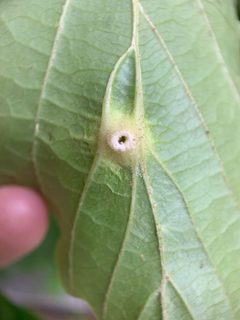
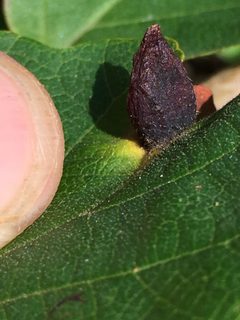
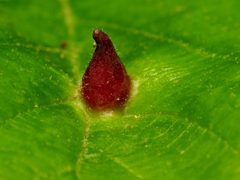
Hormaphis hamamelidis is a gall-forming that induces distinctive red, cone-shaped galls on witch-hazel (Hamamelis virginiana) leaves. The exhibits alternation, with and gall formation on witch-hazel in spring, followed by to birch (Betula) for parthenogenetic summer , and return migration to witch-hazel in autumn. Founding females (fundatrices) actively manipulate host plant phenolic metabolism, increasing condensed tannins and decreasing hydrolyzable tannins within galls to enhance their own reproductive success. Gall size, determined largely by fundatrix manipulation of plant growth, is the primary predictor of fundatrix rather than leaf position or plant vigor per se.
Pronunciation
How to pronounce Hormaphis hamamelidis: /hɔːrˈmæfɪs hæməˈmiːlɪdɪs/
These audio files are automatically generated. While they are not always 100% accurate, they are a good starting point.
Identification
Easily recognized by the presence of red, conical galls on witch-hazel leaves; each gall typically houses a single fundatrix. Galls are nutrient-rich structures distinct from ungalled leaf tissue. The itself is minute and rarely observed directly without dissection of the gall.
Images
Habitat
Forms galls on leaves of witch-hazel (Hamamelis virginiana), typically in forest understory environments. Summer occur on birch (Betula) .
Distribution
Eastern North America; confirmed records include Vermont and broader United States distribution.
Seasonality
Winter hatch in early spring, often before budbreak. Gall formation occurs spring through early summer on witch-hazel. to birch follows for summer parthenogenetic . Sexuparae return to witch-hazel in autumn to produce sexual forms and eggs.
Diet
Phloem sap obtained from within galls on witch-hazel and from birch leaves during summer .
Host Associations
- Hamamelis virginiana - primary ; site of gall formation, , and witch-hazel
- Betula - secondary ; site of summer parthenogenetic birch
Life Cycle
Complex involving alternation and both sexual and parthenogenetic . hatch in spring to produce fundatrices that induce galls on witch-hazel. Within-gall reproduction produces offspring that eventually migrate to birch. Multiple parthenogenetic occur on birch through summer. In autumn, sexuparae return to witch-hazel and produce sexual males and females that mate and produce overwintering eggs.
Behavior
Fundatrices manipulate plant growth to create galls that serve as both shelter and food source. Removal of fundatrices shortly after gall enclosure limits gall growth, demonstrating active manipulation of host tissue. Fundatrices alter host phenolic metabolism, increasing condensed tannin and decreasing hydrolyzable tannin concentrations in galls. hatch timing represents a strategy, occurring in advance of budbreak to ensure gall-forming opportunities.
Ecological Role
Gall formation creates localized nutrient sinks on plants. Gall structures may provide for other organisms, though specific or not documented in provided sources.
Human Relevance
Serves as a study system for plant-insect interactions, particularly gall formation and manipulation. Provides accessible example of complex for ecological and evolutionary research.
Similar Taxa
- Other Hormaphis speciesShares gall-forming habit on woody ; distinguished by host specificity and gall
- Other aphid gall-formersSimilar complexity; distinguished by specific association with Hamamelis virginiana and distinctive red conical gall shape
Sources and further reading
- BugGuide
- GBIF taxonomy match
- iNaturalist taxon
- NCBI Taxonomy
- Catalogue of Life
- The Life Cycle of Hormaphis Hamamelidis
- Hormaphis hamamelidis Fundatrices Benefit by Manipulating Phenolic Metabolism of Their Host
- Hormaphis hamamelidis and gall size: a test of the plant vigor hypothesis
- Opposing survivorship and fecundity effects of host phenology on the gall‐forming aphid Hormaphis hamamelidis
- Geographic variation and evolution in the life cycle of the witch-hazel leaf gall aphid, Hormaphis hamamelidis