
Macrosiphum gaurae
(Williams, 1911)
Beeblossom Aphid
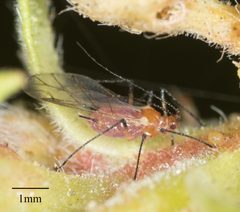
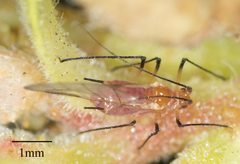
Macrosiphum gaurae, commonly known as the beeblossom , is an aphid to North America. It is distinguished by its unique coloration, including a brilliant rose pink form that is unique among North American aphids. The species is closely associated with evening primrose and beeblossom plants as its primary . Its distribution spans from the east to west coasts of North America, though it becomes increasingly rare in the Pacific Northwest region from British Columbia to Oregon.
Pronunciation
How to pronounce Macrosiphum gaurae: /ˌmækroʊˈsaɪfəm ˈɡaʊreɪ/
These audio files are automatically generated. While they are not always 100% accurate, they are a good starting point.
Identification
The pink form is readily identifiable as it is the only North American that matures to brilliant rose pink. For green or orange forms, identification relies on plant association (evening primrose or beeblossom) combined with the deep caudal indentation and black siphunculi. Macrosiphum rosae, which has similar black siphunculi, can be distinguished by its use of Rosa as hosts and its shallower caudal indentation.
Images
Appearance
exhibit two primary color forms: a brilliant rose pink form and a green form. A less common orange form has also been documented. The siphunculi (cornicles) are black. A distinctive morphological feature is a noticeable indentation toward the cauda ( spine), which differs from the shallower indentation seen in the similar Macrosiphum rosae. The pink mature form is particularly distinctive as no other North American achieves this coloration.
Habitat
Associated with native prairie and open where plants (evening primrose and beeblossom) occur. Specific microhabitat details are not well documented.
Distribution
to North America. Ranges from the Atlantic to Pacific coasts. Distribution becomes patchy and rare from British Columbia through Oregon.
Diet
Phloem feeder on evening primrose (Oenothera ) and beeblossom (Gaura species) as primary plants.
Host Associations
- Evening primrose - primary Oenothera
- Beeblossom - primary Gaura
Similar Taxa
- Macrosiphum rosaeShares black siphunculi but differs in plants (Rosa ), lacks deep caudal indentation, and does not exhibit rose pink coloration
More Details
Color polymorphism
The exhibits three documented color forms: pink (most distinctive and common), green (more common than orange), and orange (rare, infrequently observed)