
Agonoscelis puberula
Stål, 1853
African cluster bug
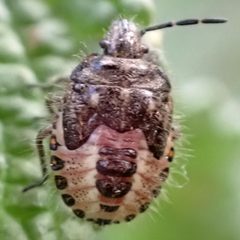
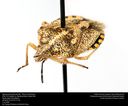
Agonoscelis puberula, commonly known as the African cluster , is a in the Pentatomidae. Native to Africa, it has established in the Western Hemisphere following introduction events. The earliest confirmed record in the Americas dates to 1978 from Cuba, predating the 1985 record previously considered the first. The species is now present throughout the Caribbean, Central America, and North America. Its spread to Cuba has been hypothesized to relate to Cuban military engagement in Angola during the Cold War.
Pronunciation
How to pronounce Agonoscelis puberula: /ˌæɡoʊnoʊˈsɛlɪs ˌpjuːbəˈruːlə/
These audio files are automatically generated. While they are not always 100% accurate, they are a good starting point.
Images
Distribution
Native to Africa, with confirmed records from Botswana, Namibia, South Africa, and Zambia. Introduced to the Western Hemisphere, where it occurs in Cuba (first recorded 1978), the broader Caribbean, Central America, and North America. The 1978 Cuban specimen represents the oldest known record of this in the New World.
Human Relevance
An introduced in the Americas with potential agricultural significance as a member of the Pentatomidae, though specific crop impacts are not documented in the available sources.
More Details
Introduction History
The 1978 Cuban record predates by seven years the 1985 record previously considered the earliest in the Western Hemisphere. This suggests an earlier introduction than previously recognized, possibly associated with Cuban military transport from Angola during Cold War conflicts in tropical Africa.